
Introduction: Two Major Approaches to Warehouse Material Flow
When planning warehouse automation, two of the most frequently compared technologies are Autonomous Mobile Robots (AMRs / mobile robots) and traditional conveyor systems.
- Conveyor systems — fixed infrastructure (roller, belt, chain, overhead, etc.) that continuously or on-demand moves goods along predetermined paths
- Mobile robots (AMRs) — autonomous, intelligent vehicles that transport goods using dynamic navigation (LiDAR + SLAM) without fixed tracks
Both solutions aim to reduce manual transport, increase throughput and improve consistency, but they differ dramatically in philosophy, cost structure, flexibility and suitability for different operational profiles.
This article provides a detailed, up-to-date comparison to help warehouse operators, logistics managers and automation consultants choose the most appropriate technology — or combination — for their specific needs.
For an overview of the complete range of mobile robot applications, see our comprehensive pillar guide:
[Internal Link: Mobile Robots for Warehouse Management]
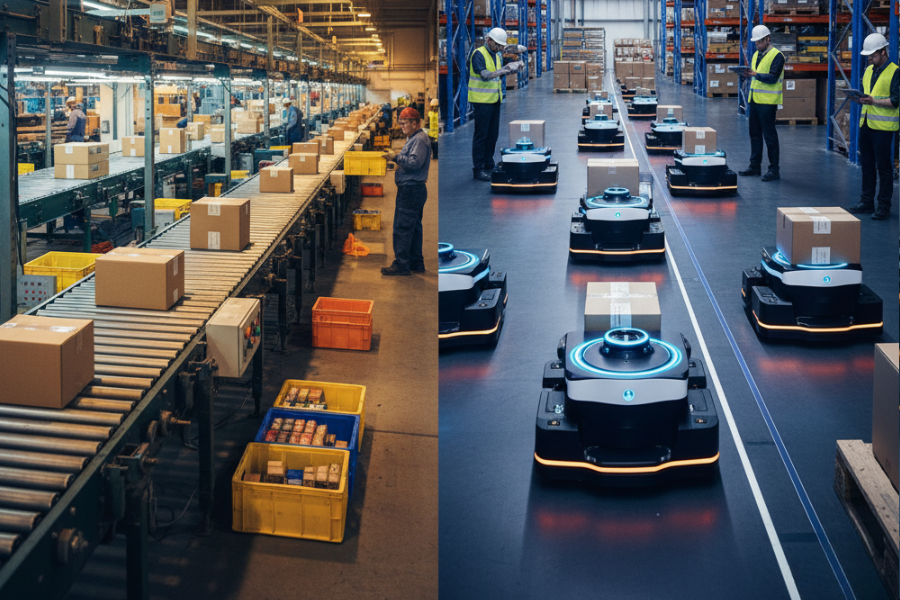
Detailed Comparison Table
| Criterion | Autonomous Mobile Robots (AMRs) | Conveyor Systems | Clear Winner (most situations 2024–2026) |
|---|---|---|---|
| Initial Capital Investment | Medium–High per unit (25–120 k€) • low system entry cost | High – very high (especially for long/complex lines) | AMRs |
| Total Cost of Ownership (5y) | Usually lower (flexible scaling, less infrastructure) | Often higher after modifications & maintenance | AMRs |
| Flexibility / Reconfigurability | Excellent – software change + minor physical rearrangement | Very low – major civil/infrastructure work required | AMRs |
| Scalability | Very good – add units incrementally, fast deployment | Limited – stepwise, expensive expansions | AMRs |
| Installation time | Days to few weeks | Weeks to many months | AMRs |
| Space requirements | Good – can use narrow aisles, shared human-robot space | High – needs dedicated space & clearance | AMRs |
| Maintenance | Moderate (batteries, sensors, software updates) | High (mechanical wear, many moving parts, lubrication) | AMRs |
| Throughput – steady state | Good–very good (fleet optimization critical) | Excellent (when running at capacity) | Conveyors |
| Throughput – variable/seasonal | Excellent (easy to add/remove capacity) | Poor (overcapacity expensive, undercapacity bottleneck) | AMRs |
| Change of product mix / layout | Very good | Very poor | AMRs |
| Human–robot coexistence | Excellent (safety-rated sensors & speeds) | Limited (usually requires guarding/separation) | AMRs |
| Energy consumption | Moderate–good (optimized routes, charging management) | Good when fully loaded, poor when partially loaded | Roughly equal |
| Failure impact | Localized (one robot down → others compensate) | Potentially systemic (one section down can stop flow) | AMRs |
| Best suited environment | Variable volume, frequent layout changes, mixed operations | Extremely high, stable volume, fixed product flow | — |
[External Link: Warehouse Automation Comparison Study]
Deep Dive: Cost, Flexibility & Scalability
1. Cost Structure
Conveyors
- Very high upfront cost (design, manufacturing, civil works, electrical installation)
- Costs scale poorly with distance & complexity
- Modifications/expansions extremely expensive
AMRs
- Cost per robot has decreased significantly (2024–2026 price range)
- Main expenses: robots + charging stations + fleet management software
- Incremental scaling: add 5–10 robots instead of building new conveyor line
- Robot-as-a-Service (RaaS) models further reduce initial capital barrier
Verdict: For most warehouses under ~50,000–80,000 m² with changing requirements → AMRs usually have better 5–7 year TCO.
2. Flexibility & Reconfigurability
Conveyor systems are fundamentally path-fixed. Any significant change (new zone, different process flow, seasonal rearrangement) requires mechanical/electrical modifications — often with weeks/months of downtime.
AMRs are path-free (software-defined).
Typical reconfiguration time: hours to few days
→ ideal for:
- e-commerce & omnichannel warehouses
- 3PL operations with changing clients
- seasonal peaks
- frequent layout optimization
- test & learn automation approach
3. Scalability
Conveyors scale in large steps → difficult to match exact demand curve
AMRs scale in small increments (add/remove 1–5 robots) → excellent for:
- Growing businesses
- Strong seasonal variation
- Phased automation implementation
Installation and Maintenance Comparison
Installation
Conveyor systems
- Require detailed engineering design
- Significant civil works (foundations, supports)
- Electrical & control cabinet installation
- Long commissioning & testing phase
- Usually 2–12+ months from order to operation
AMRs
- Floor condition check + basic mapping
- Robot delivery & initial fleet configuration
- Integration with WMS/WES
- Training & go-live
- Typically 2 weeks – 3 months
Maintenance
Conveyors
- Many mechanical wear parts (rollers, belts, chains, bearings, motors)
- Regular lubrication & alignment needed
- Downtime for section maintenance affects whole line
AMRs
- Main wear items: drive wheels, batteries
- Sensors & computers very reliable (industrial grade)
- Predictive maintenance via fleet software
- Single robot maintenance has limited system impact
Use-case Recommendations: When to Choose Which
Choose Conveyor Systems when:
- Extremely high, very stable throughput (single product family, 24/7 operation)
- Long, well-defined transport distances with minimal branching
- Very tight unit cost per move is critical (conveyors can reach lowest cost/move at full utilization)
- Brownfield → already has substantial conveyor infrastructure
- Examples: large distribution centers for retail hard goods, beverage bottling plants, high-volume parcel hubs with fixed sort patterns
Choose Mobile Robots (AMRs) when:
- Medium to high throughput with significant variation (seasonal, daily, product mix)
- Frequent layout/process changes
- Need for human–robot shared spaces
- Phased automation implementation desired
- Strong desire for future-proofing / easy technology upgrade path
- Examples: e-commerce fulfillment centers, fashion & multi-SKU retail DC, 3PL, manufacturing supermarkets, micro-fulfillment centers, growing mid-size warehouses
Hybrid approach (very common 2024–2026)
Fixed conveyors for very high-volume straight main arteries
AMRs for feeding spurs, buffering, cross-docking, variable zones, value-added services
Conclusion
Mobile robots (AMRs) and conveyor systems are not direct substitutes — they serve different operational philosophies.
Conveyor systems remain the gold standard for ultra-high volume, extremely stable, fixed-flow environments where minimizing cost per move at maximum capacity is the dominant KPI.
Autonomous Mobile Robots have become the default choice for the majority of modern warehouses due to their:
- superior flexibility
- easier & faster implementation
- natural scalability
- better adaptation to variable demand
- easier human integration
- lower risk of large-scale project failure
For most warehouses that are not operating in the very top tier of fixed high-volume distribution, mobile robots currently offer the better risk/reward profile in 2025–2026.
Want to evaluate which technology (or combination) fits your specific operation best? Use our pillar guide as starting point and then book a consultation with automation specialists:
[Internal Link: Mobile Robots for Warehouse Management]
To understand how these systems work together, read our complete guide on mobile robots for warehouse management.