
Introduction: The IoT Revolution Demands a New Breed of Developer
The Internet of Things (IoT) represents one of the most significant technological shifts of our time, connecting physical devices to digital ecosystems at an unprecedented scale. By 2025, projections suggest over 75 billion connected devices worldwide, transforming everything from home appliances to industrial machinery into intelligent, data-generating assets.
Yet for every successful IoT product that reaches the market, countless others fail during development. The primary reason? IoT product development isn’t a single discipline—it’s a complex ecosystem of interdependent skills spanning hardware, software, connectivity, and business domains. Understanding this ecosystem isn’t just helpful; it’s essential for anyone serious about building IoT solutions that work in the real world.
What IoT Product Development Really Means
IoT product development is the end-to-end process of creating connected devices that collect, transmit, and act on data, integrated into broader systems that deliver tangible value. Unlike traditional embedded systems, IoT products live in networked environments, requiring considerations far beyond the device itself—cloud infrastructure, data pipelines, security protocols, and user interfaces all form part of the complete product.
The critical distinction lies between IoT projects and real-world IoT products. A project might connect a sensor to the internet using an Arduino. A product does this reliably for 100,000 devices across different environments, with secure over-the-air updates, proper data management, regulatory compliance, and a sustainable business model. The former is a technical exercise; the latter is a complex orchestration of technology, business, and user needs.
Why Multidisciplinary Skills Are Non-Negotiable
Imagine building a house with only carpenters. No electricians, plumbers, or architects. The result would be structurally unsound and functionally useless. Similarly, IoT development requires a symphony of specialists or versatile generalists who understand how each component interacts.
Consider a smart agricultural sensor:
- Hardware engineers design the moisture sensor and housing
- Embedded developers program the microcontroller to read sensor data
- Network specialists ensure reliable communication from remote fields
- Cloud developers process and store incoming data
- Data scientists analyze patterns to predict irrigation needs
- Security experts protect against tampering
- Product managers ensure farmers can actually use the insights
Each discipline brings essential expertise, and gaps in any area can compromise the entire system.
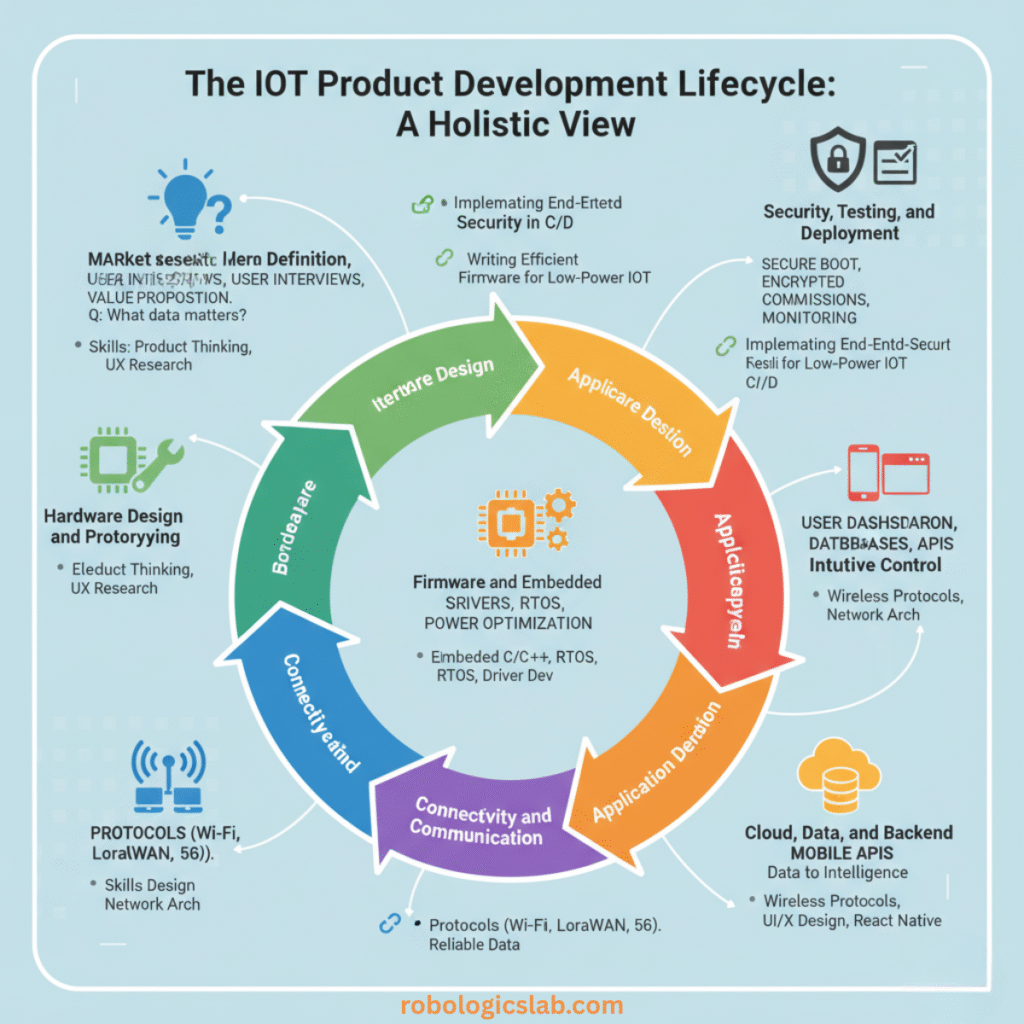
The IoT Product Development Lifecycle: A Holistic View
1. Ideation and Problem Definition
Before writing a single line of code, successful IoT products solve specific problems for identifiable users. This phase involves market research, user interviews, and defining clear value propositions. Questions like “What data matters?” and “How will this improve the user’s situation?” must be answered before technical decisions are made.
Skills involved: Product thinking, market analysis, user experience research, requirement specification.
2. Hardware Design and Prototyping
This transforms concepts into physical devices. Selection of sensors, microcontrollers, power systems, and enclosures happens here, balancing performance, cost, and manufacturability. Multiple prototyping iterations refine the design before production.
Skills involved: Electronics design, PCB layout, sensor integration, power management, thermal design, mechanical engineering.
[PCB Design Fundamentals for IoT Devices]
3. Firmware and Embedded Software Development
The “brain” of the IoT device, firmware manages hardware components efficiently while preparing data for transmission. This includes low-level drivers, real-time operating systems, and power optimization for battery-operated devices.
Skills involved: Embedded C/C++, RTOS, driver development, memory management, interrupt handling.
[Internal link placeholder: Writing Efficient Firmware for Low-Power IoT Devices]
4. Connectivity and Communication
IoT devices need to talk—to each other, to gateways, and to the cloud. Selecting appropriate protocols (Bluetooth, Wi-Fi, LoRaWAN, cellular) depends on range, bandwidth, power, and cost requirements. This layer ensures reliable data transmission in diverse environments.
Skills involved: Wireless protocols, network architecture, gateway configuration, signal processing.
5. Cloud, Data, and Backend Development
The “cloud” in IoT is where data transforms into intelligence. This involves scalable infrastructure to handle device connections, data ingestion pipelines, databases for time-series data, and APIs for external access.
Skills involved: Cloud platforms (AWS IoT, Azure IoT), database design, API development, microservices architecture, scalability planning.
6. Application Development (Frontend/Mobile)
Users interact with IoT systems through dashboards and mobile apps. These interfaces must present complex data intuitively, enable device control, and provide actionable insights. Progressive Web Apps (PWAs) and native mobile apps each have their place depending on use cases.
Skills involved: React/React Native, Flutter, UI/UX design, data visualization, responsive design.
7. Security, Testing, and Deployment
Security must be baked in, not bolted on—from secure boot on devices to encrypted communications and access controls. Rigorous testing across environments precedes phased deployment, with monitoring systems to catch issues early.
Skills involved: Security protocols, penetration testing, CI/CD for IoT, device management, monitoring/alerting.
[Internal link placeholder: Implementing End-to-End Security in IoT Systems]
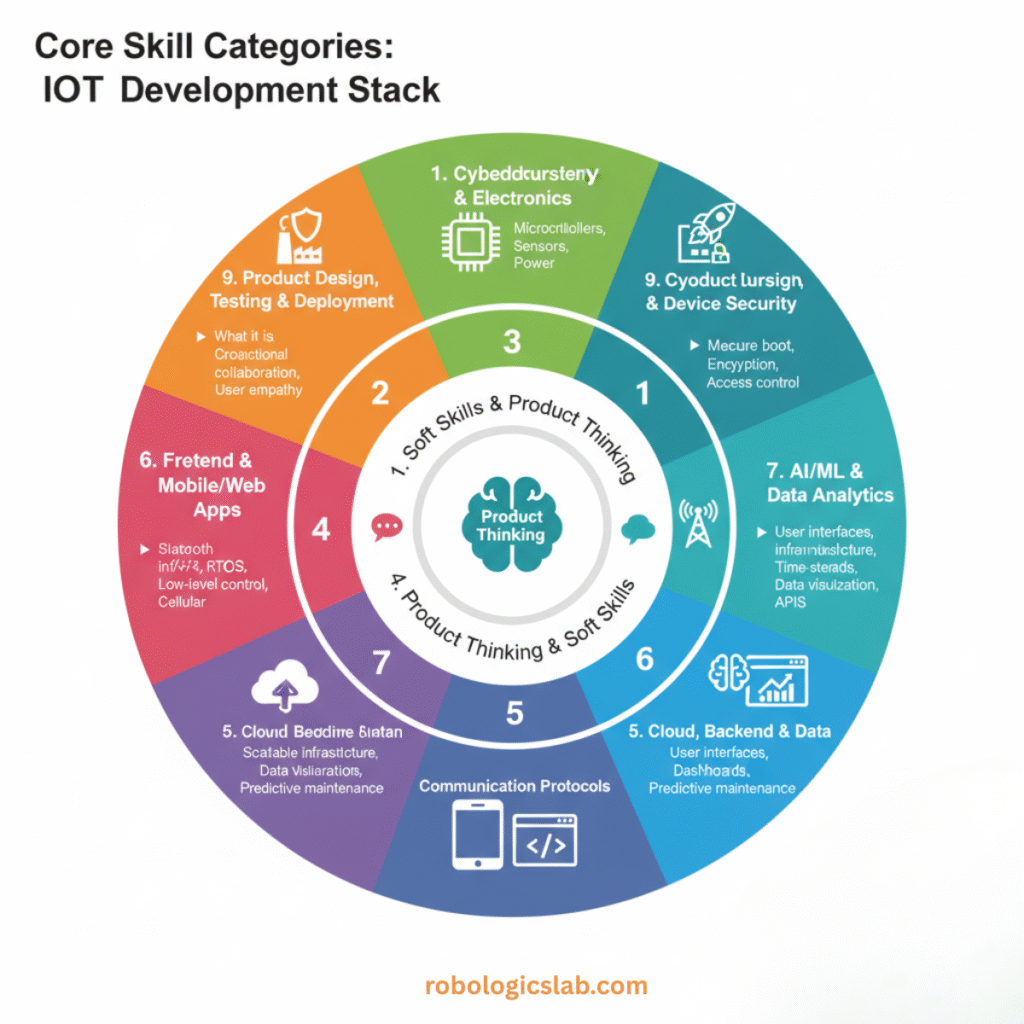
Core Skill Categories: The IoT Development Stack
1. Embedded Systems and Electronics
What it is: The foundation of IoT devices—microcontrollers, sensors, actuators, and power systems designed for specific physical interactions.
Why it matters: Poor hardware design leads to unreliable devices, excessive power consumption, or costly manufacturing. IoT hardware must survive real-world conditions while meeting strict power budgets.
Real-world application: Designing a wearable fitness tracker involves selecting energy-efficient sensors, optimizing PCB layout for small form factors, and implementing power-saving sleep modes.
2. Programming and Firmware Development
What it is: Low-level software that directly controls hardware, typically written in C/C++ for resource-constrained environments.
Why it matters: Efficient firmware extends battery life, ensures responsive device behavior, and enables reliable operation without constant reboots.
Real-world application: Smart thermostat firmware manages temperature readings, display updates, Wi-Fi connectivity, and cloud communication while maximizing battery life.
3. Communication Protocols and Networking
What it is: Technologies enabling devices to exchange data—from short-range Bluetooth to wide-area cellular IoT.
Why it matters: Different IoT applications have vastly different connectivity needs. Choosing wrong protocols leads to connectivity gaps, excessive costs, or rapid battery drain.
Real-world application: Industrial IoT sensors in remote locations might use LoRaWAN for long-range, low-power communication to a gateway, which then uses cellular to reach the cloud.
4. Cloud, Backend, and Data Handling
What it is: Scalable infrastructure that receives, processes, stores, and serves IoT data to applications.
Why it matters: IoT generates massive streams of time-series data that traditional databases struggle with. Cloud platforms provide managed services specifically for IoT workloads.
Real-world application: A fleet management system processes GPS data from thousands of vehicles, applying business rules to generate alerts, optimizing routes, and providing analytics dashboards.
5. Frontend and Mobile/Web Applications
What it is: User interfaces that make IoT data accessible and actionable.
Why it matters: Without intuitive interfaces, even the most sophisticated IoT systems fail to deliver value. Users need clear visualizations and simple controls.
Real-world application: Smart home apps allow users to control lights, view security cameras, and set automation routines from their smartphones with minimal complexity.
6. AI/ML and Data Analytics (The Intelligence Layer)
What it is: Extracting patterns, predictions, and automated decisions from IoT data streams.
Why it matters: Raw IoT data has limited value. Analytics transforms data into insights, while AI enables predictive maintenance, anomaly detection, and autonomous operation.
Real-world application: Predictive maintenance in manufacturing analyzes vibration and temperature data to forecast equipment failures before they occur, reducing downtime.
7. Cybersecurity and Device Security
What it is: Protecting IoT systems from unauthorized access, data breaches, and malicious control.
Why it matters: Insecure IoT devices become attack vectors for networks, compromise user privacy, and can cause physical harm in critical applications.
Real-world application: Medical IoT devices implement secure boot, encrypted communications, and regular security patches to protect patient data and ensure device integrity.
8. Product Design, Testing, and Deployment
What it is: Ensuring IoT solutions are manufacturable, reliable, user-friendly, and maintainable at scale.
Why it matters: Moving from prototype to production involves supply chain management, regulatory compliance, quality control, and scalable deployment processes.
Real-world application: Consumer IoT products undergo environmental testing, certification for wireless standards, packaging design, and creation of over-the-air update systems.
9. Soft Skills and Product Thinking
What it is: Cross-functional collaboration, user empathy, system thinking, and business awareness.
Why it matters: IoT development involves constant trade-offs between technical possibilities, user needs, and business constraints. Effective communication across specialties is crucial.
Real-world application: Explaining technical constraints to business stakeholders, or understanding user frustrations to improve product design.
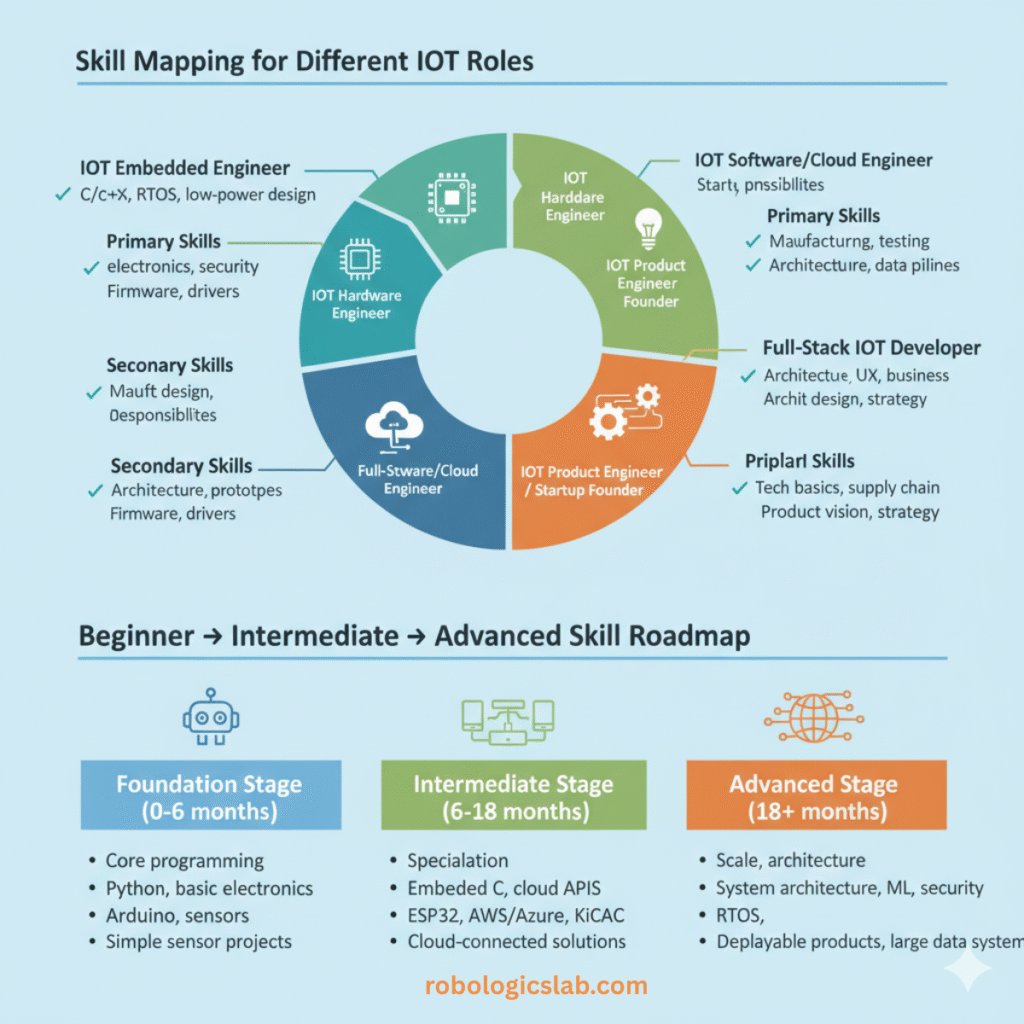
Skill Mapping for Different IoT Roles
IoT Embedded Engineer
Primary skills: Embedded C/C++, RTOS, microcontroller architecture, peripheral interfaces, low-power design
Secondary skills: Basic electronics, communication protocols, security fundamentals
Typical responsibilities: Device firmware, driver development, performance optimization
IoT Hardware Engineer
Primary skills: PCB design, sensor integration, power electronics, RF design, thermal management
Secondary skills: Manufacturing processes, testing methodologies, cost optimization
Typical responsibilities: Circuit design, component selection, prototype validation, production support
IoT Software/Cloud Engineer
Primary skills: Cloud platforms (AWS/Azure IoT services), database design, microservices, API development
Secondary skills: Device communication protocols, security implementation, scalability patterns
Typical responsibilities: Cloud infrastructure, data pipelines, backend services, API design
Full-Stack IoT Developer
Primary skills: Embedded programming, cloud services, web/mobile development
Secondary skills: System architecture, security, data visualization
Typical responsibilities: End-to-end feature implementation, from device to user interface
IoT Product Engineer / Startup Founder
Primary skills: System architecture, project management, user experience, business strategy
Secondary skills: Basic understanding of all technical domains, supply chain management, regulations
Typical responsibilities: Product vision, team coordination, technical decision-making, stakeholder communication
Beginner → Intermediate → Advanced Skill Roadmap
Foundation Stage (0-6 months)
Focus: Core programming and electronics fundamentals
Skills: Python basics, simple circuits, introductory electronics, basic data structures
Tools: Arduino, Raspberry Pi, basic sensors, breadboards
Projects: Simple sensor projects, basic automation, introductory data logging
Intermediate Stage (6-18 months)
Focus: Specialization and integration
Skills: Embedded C, wireless protocols, cloud APIs, basic PCB design
Tools: ESP32, STM32, MQTT, basic AWS/Azure services, KiCad/Eagle
Projects: Complete IoT solutions with cloud connectivity, custom PCBs, mobile interfaces
Advanced Stage (18+ months)
Focus: Scale, optimization, and architecture
Skills: System architecture, advanced security, machine learning integration, production design
Tools: RTOS, cellular IoT, Kubernetes for IoT, advanced analytics platforms
Projects: Deployable products, manufacturing preparation, large-scale data systems
[Internal link placeholder: Complete IoT Learning Path: From Arduino to Production]
Industry Trends Shaping IoT Skill Requirements
Edge AI and TinyML
Moving intelligence from cloud to device reduces latency, conserves bandwidth, and enhances privacy. Skills in optimizing ML models for resource-constrained devices are becoming essential.
Digital Twins
Virtual replicas of physical systems enable simulation, monitoring, and optimization. This requires skills in 3D modeling, simulation, and real-time data synchronization.
Industry 4.0 and Smart Manufacturing
Industrial IoT demands reliability, interoperability, and security. Skills in OPC UA, time-sensitive networking, and industrial protocols are increasingly valuable.
Smart Cities and Infrastructure
Large-scale deployments require skills in mesh networking, long-range communication, public-private partnerships, and data governance.
Healthcare IoT
Regulatory compliance (FDA, HIPAA), medical device standards, and extreme reliability requirements create specialized skill needs in this sector.
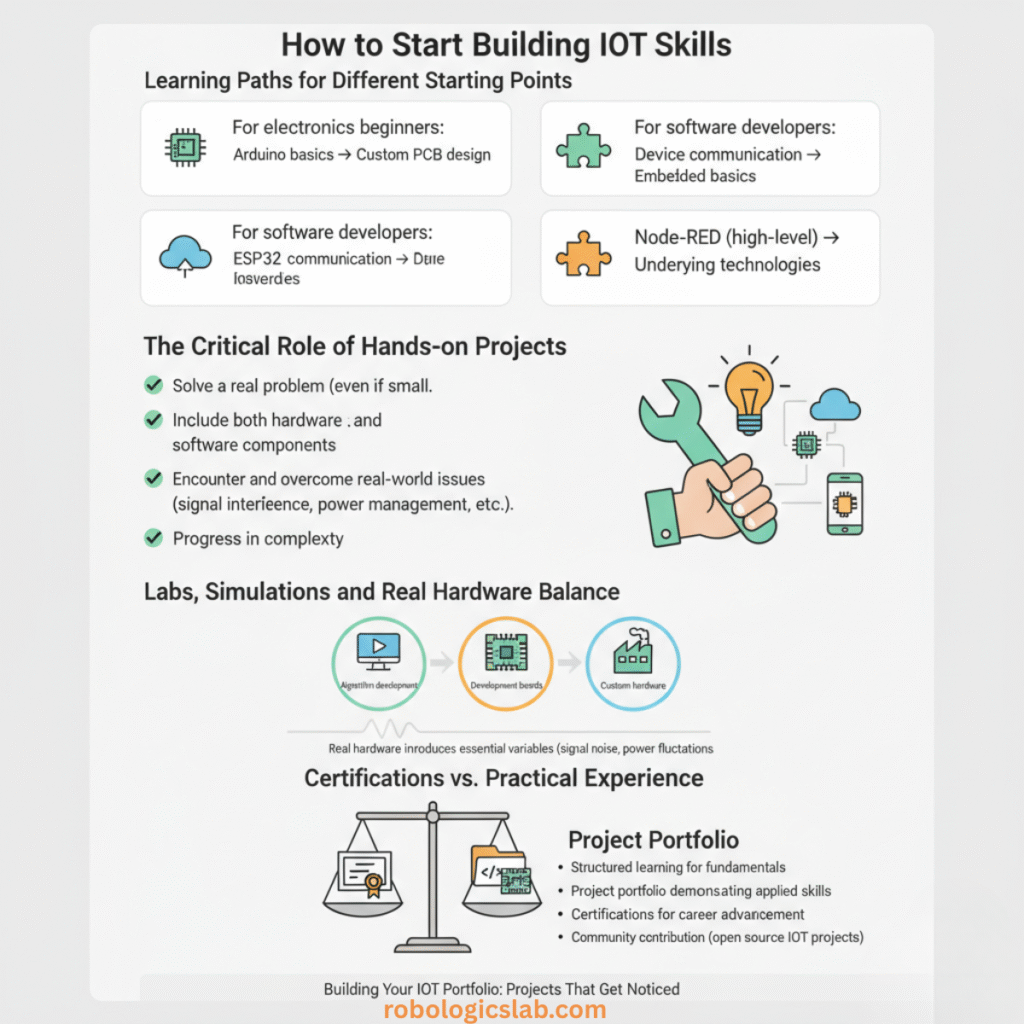
How to Start Building IoT Skills
Learning Paths for Different Starting Points
For electronics beginners: Start with Arduino basics, then progress to ESP32 and custom PCB design
For software developers: Begin with cloud-side IoT services, then learn device communication and embedded basics
For complete beginners: Start with high-level platforms like Node-RED, then work backward to understand underlying technologies
The Critical Role of Hands-on Projects
Theory alone cannot prepare you for IoT development. Each project should:
- Solve a real problem (even if small)
- Include both hardware and software components
- Encounter and overcome real-world issues (signal interference, power management, etc.)
- Progress in complexity
Labs, Simulations, and Real Hardware Balance
While simulators (like Wokwi) help learn concepts, real hardware introduces essential variables—signal noise, power fluctuations, environmental factors. A balanced approach uses:
- Simulations for algorithm development
- Development boards for prototyping
- Custom hardware for production preparation
Certifications vs. Practical Experience
Certifications (AWS Certified IoT Specialty, etc.) validate knowledge but don’t replace portfolio projects. The most effective approach combines:
- Structured learning for fundamentals
- Project portfolio demonstrating applied skills
- Certifications for career advancement
- Community contribution (open source IoT projects)
[Internal link placeholder: Building Your IoT Portfolio: Projects That Get Noticed]
Conclusion: The Journey to IoT Mastery
The IoT skill ecosystem is vast, but approachable through systematic learning. Remember:
- Start with your strengths but expand strategically into adjacent domains
- Build complete systems rather than isolated components—even simple end-to-end projects teach integration skills
- Specialize deeply in one area while maintaining working knowledge of others
- Stay curious and adaptable—IoT technology evolves rapidly
The most successful IoT professionals aren’t just experts in their niche; they understand how their work fits into the complete system. They communicate across disciplines, make informed trade-offs, and maintain user-centric perspectives throughout technical decisions.
IoT represents not just technological integration, but the integration of disciplines, teams, and perspectives. As you develop these skills, you’re not just learning technologies—you’re learning to bridge the physical and digital worlds, creating solutions that meaningfully improve how we live and work.
[Internal link placeholder: IoT Career Pathways: From Student to Industry Professional]
[Internal link placeholder: IoT Project Planning Template: From Idea to Deployment]
[Internal link placeholder: Common IoT Pitfalls and How to Avoid Them]
Begin your IoT journey today. Pick one skill gap, start a small project, and progressively expand your expertise. The connected future won’t build itself—it needs developers who understand the complete picture.
FAQs on IoT Product Development Skills
1. What’s the single most important skill for getting started with IoT development?
Answer:
Programming fundamentals—specifically Python or C/C++—are the most critical starting point. While IoT spans hardware and software, programming serves as the foundation that enables you to work with microcontrollers, process data, create APIs, and eventually learn other domains. Start with Python for its versatility, then transition to C for embedded systems. Many IoT platforms like MicroPython and CircuitPython now bridge these worlds, making the learning curve smoother for beginners.
[Internal link: “Python vs. C for IoT: Choosing Your First Language”]
2. Do I need an electronics degree to develop IoT hardware?
Answer:
No, but you need electronics knowledge. Many successful IoT developers come from software backgrounds and learn electronics through practical projects. Start with development boards like Arduino or ESP32, which abstract complex electronics. As you progress, learn:
- Basic circuit design
- Reading datasheets
- PCB design with tools like KiCad
- Power management fundamentals
Resources like online courses, maker communities, and hands-on experimentation can build this knowledge effectively without a formal degree. The key is progressive learning through projects of increasing complexity.
[Internal link: “Electronics Self-Study Guide for Software Engineers”]
3. What’s the biggest difference between IoT prototypes and production-ready products?
Answer:
Production readiness introduces critical considerations often overlooked in prototypes:
| Prototypes | Production Products |
|---|---|
| Development boards | Custom PCBs |
| Breadboard connections | Soldered components |
| Manual updates | Over-the-air (OTA) updates |
| Basic security | End-to-end security |
| Limited testing | Environmental/regulatory testing |
| Individual units | Scalable manufacturing |
| Proof of concept | User experience focus |
The leap involves reliability, scalability, security, manufacturability, and maintainability. A prototype proves it can work; a product ensures it will work for thousands of users in diverse conditions.
[Internal link: “From Prototype to Production: The IoT Hardware Journey”]
4. Which IoT communication protocol should I learn first?
Answer:
Start with MQTT (Message Queuing Telemetry Transport) because:
- It’s lightweight and ideal for constrained devices
- It’s widely adopted across consumer and industrial IoT
- The publish-subscribe model is foundational to understanding IoT messaging
- It works across Wi-Fi, cellular, and LPWAN networks
- Excellent learning resources and tools (like Mosquitto broker) are available
After MQTT, explore HTTP/REST for device management, then Bluetooth Low Energy for short-range applications, and finally LoRaWAN or cellular for wide-area needs.
[Internal link: “IoT Communication Protocols: When to Use Each”]
5. How much cloud knowledge is necessary for IoT development?
Answer:
Essential cloud knowledge includes:
- Device management: Registering, monitoring, and updating devices
- Data ingestion: Handling streaming data from multiple devices
- Basic storage: Time-series databases and blob storage
- APIs: Creating endpoints for applications
- Security: Implementing authentication and authorization
You don’t need to be a cloud architect, but understanding how to use managed IoT services (AWS IoT Core, Azure IoT Hub) is crucial. Start with one cloud provider’s IoT services, as concepts transfer across platforms.
[Internal link: “AWS vs. Azure vs. Google Cloud for IoT: Getting Started Guide”]
6. Can I specialize in just one area of IoT, or do I need to know everything?
Answer:
You absolutely can specialize, but T-shaped knowledge is ideal:
- Deep expertise in one area (embedded systems, cloud, security, etc.)
- Working knowledge of adjacent domains to collaborate effectively
- Awareness of the complete ecosystem to understand dependencies
Specialization makes you valuable for complex implementations, while breadth enables you to architect solutions and communicate across teams. In startups or small teams, broader skills are necessary; in larger organizations, deeper specialization is possible.
[Internal link: “Career Paths in IoT: Specialist vs. Generalist”]
7. What are the most important security skills for IoT developers?
Answer:
Critical IoT security skills include:
- Device security: Secure boot, hardware security modules, firmware signing
- Communication security: TLS/DTLS implementation, certificate management
- Cloud security: IAM policies, API security, data encryption at rest
- Update security: Signed OTA updates, rollback mechanisms
- Vulnerability assessment: Regular security testing and patch management
Start with implementing TLS for device-cloud communication and secure credential storage. Remember: IoT security is weakest at the intersection points between components, so focus on end-to-end security rather than isolated protections.
[Internal link: “Practical IoT Security: Implementation Checklist”]
8. How do I choose between Arduino, ESP32, Raspberry Pi, and STM32?
Answer:
Selection depends on your project requirements:
| Platform | Best For | When to Avoid |
|---|---|---|
| Arduino | Learning, quick prototyping, simple sensors | Production, complex processing, networking |
| ESP32 | Wi-Fi/Bluetooth projects, mid-complexity, cost-sensitive | High-performance computing, industrial environments |
| Raspberry Pi | Complex processing, camera/display projects, Linux-based | Battery-powered, cost-sensitive, simple control |
| STM32 | Production products, real-time requirements, industrial applications | Beginners, rapid prototyping without development boards |
Start with Arduino for fundamentals, move to ESP32 for connected projects, and explore STM32 when preparing for production.
[Internal link: “Microcontroller Selection Guide for IoT Projects”]
9. What soft skills are most valuable for IoT professionals?
Answer:
Essential soft skills for IoT success:
- Systems thinking: Understanding how components interact
- Communication: Translating technical concepts for diverse stakeholders
- Problem decomposition: Breaking complex problems into manageable parts
- Adaptability: Learning new technologies as the ecosystem evolves
- User empathy: Designing for real user needs, not just technical elegance
The interdisciplinary nature of IoT demands collaboration across traditionally siloed teams. Being able to explain hardware constraints to software developers, or cloud limitations to hardware engineers, accelerates development and prevents costly rework.
[Internal link: “The IoT Team: Communication Strategies for Cross-Functional Success”]
10. How do I stay current with rapidly evolving IoT technologies?
Answer:
Effective strategies for staying current:
- Follow industry leaders: Subscribe to IoT-specific newsletters and podcasts
- Engage with communities: Participate in forums, local meetups, and conferences
- Hands-on experimentation: Regularly build with new platforms and tools
- Continuous learning: Take short courses on emerging areas (Edge AI, digital twins, etc.)
- Monitor standards: Follow evolution of protocols and certifications
Create a learning rhythm: daily scanning of industry news, weekly deep dives into one topic, quarterly projects with new technologies. Focus on understanding principles rather than memorizing tools—the underlying concepts outlast specific implementations.
[Internal link: “IoT Learning Resources: Staying Ahead in a Fast-Moving Field”]