
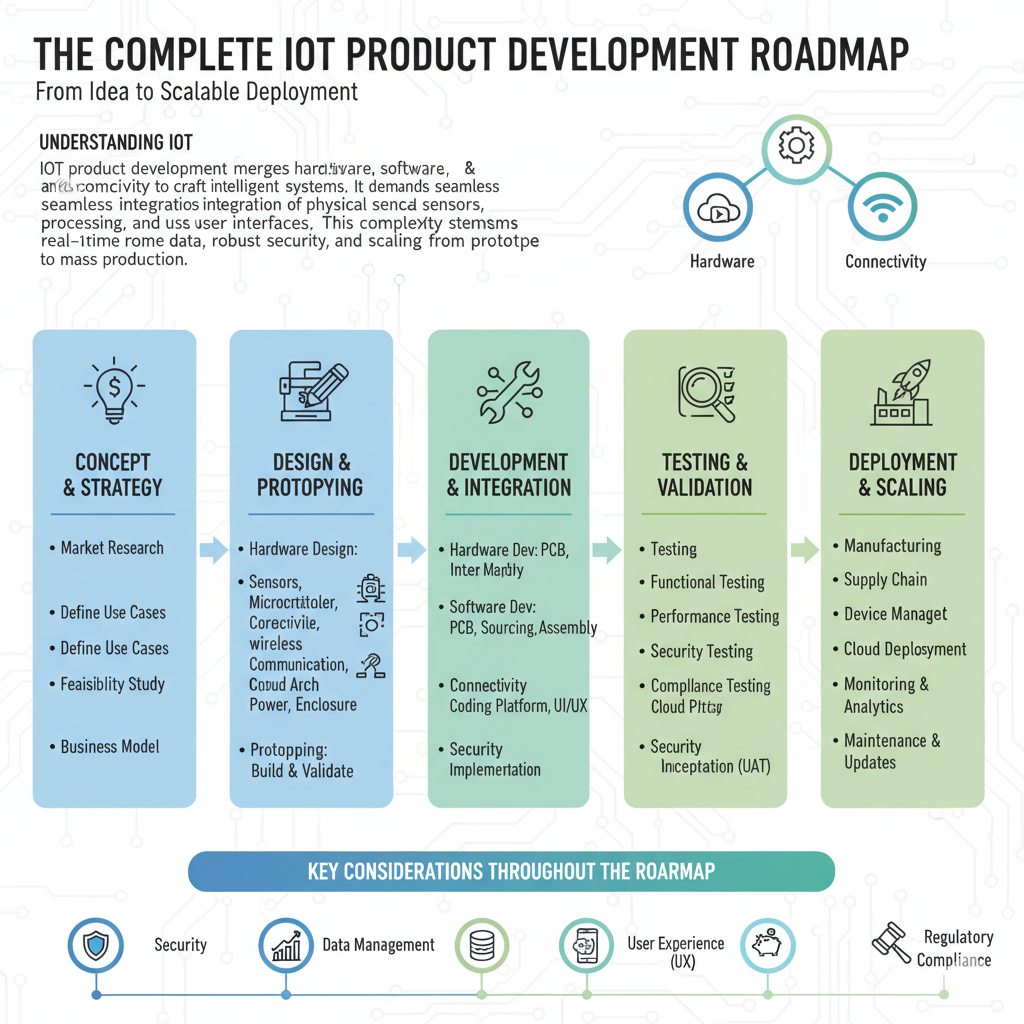
IoT product development represents the convergence of hardware, software, and connectivity to create intelligent systems that transform everyday objects into data-driven solutions. Unlike traditional electronics that operate in isolation or pure software applications that run on standardized platforms, IoT products must seamlessly integrate physical sensors, wireless communications, cloud processing, and user interfaces while maintaining reliability across diverse environments. This complexity arises from the need to handle real-time data flows, ensure robust security against evolving threats, and scale from prototypes to mass production without compromising performance or cost efficiency.
This guide is designed for engineers, IoT learners, startups, founders, and product managers navigating the IoT development stages. Readers will gain a structured understanding of the IoT product roadmap, from initial idea validation through to manufacturing and maintenance. By following this comprehensive approach, you’ll learn how to avoid common pitfalls, optimize resources, and build production-ready IoT systems that deliver real value. The primary focus throughout is on practical strategies for creating scalable IoT hardware to cloud architecture that meets market demands in 2026 and beyond.
What Is IoT Product Development?
IoT product development is the systematic process of designing, building, and deploying connected devices that collect, process, and exchange data over networks to enable intelligent decision-making. At its core, it involves creating ecosystems where physical hardware interacts with digital software to solve real-world problems, from monitoring industrial equipment to optimizing home energy use.
The IoT ecosystem comprises four fundamental components: the device layer (sensors and actuators), connectivity layer (wireless protocols like Wi-Fi or cellular), cloud layer (data storage and analytics), and application layer (user interfaces for control and insights). These elements must work in harmony to deliver value, with data flowing securely from edge devices to centralized platforms.
A key distinction lies between IoT prototypes and production-ready products. Prototypes are proof-of-concept builds using off-the-shelf components like Arduino or Raspberry Pi to validate basic functionality in controlled settings. In contrast, production IoT products require optimized designs for manufacturability, including custom PCBs, robust enclosures, and compliance with standards like FCC or CE for real-world deployment.
Real-world examples illustrate this evolution. In smart homes, devices like Nest Thermostats use sensors to learn user patterns and adjust heating automatically, integrating with cloud services for remote control. Industrial IoT applications, such as GE’s Predix platform, monitor jet engines in real-time to predict maintenance needs, reducing downtime by up to 20%. In healthcare, wearable devices like Fitbit track vital signs and sync data to apps for personalized health insights, demonstrating how IoT bridges physical monitoring with digital analysis.
A typical IoT system architecture follows a layered model: perception (sensing), network (transmission), processing (analytics), and application (user interaction). This structure ensures efficient data handling while addressing challenges like latency and power consumption.
The Complete IoT Product Development Lifecycle
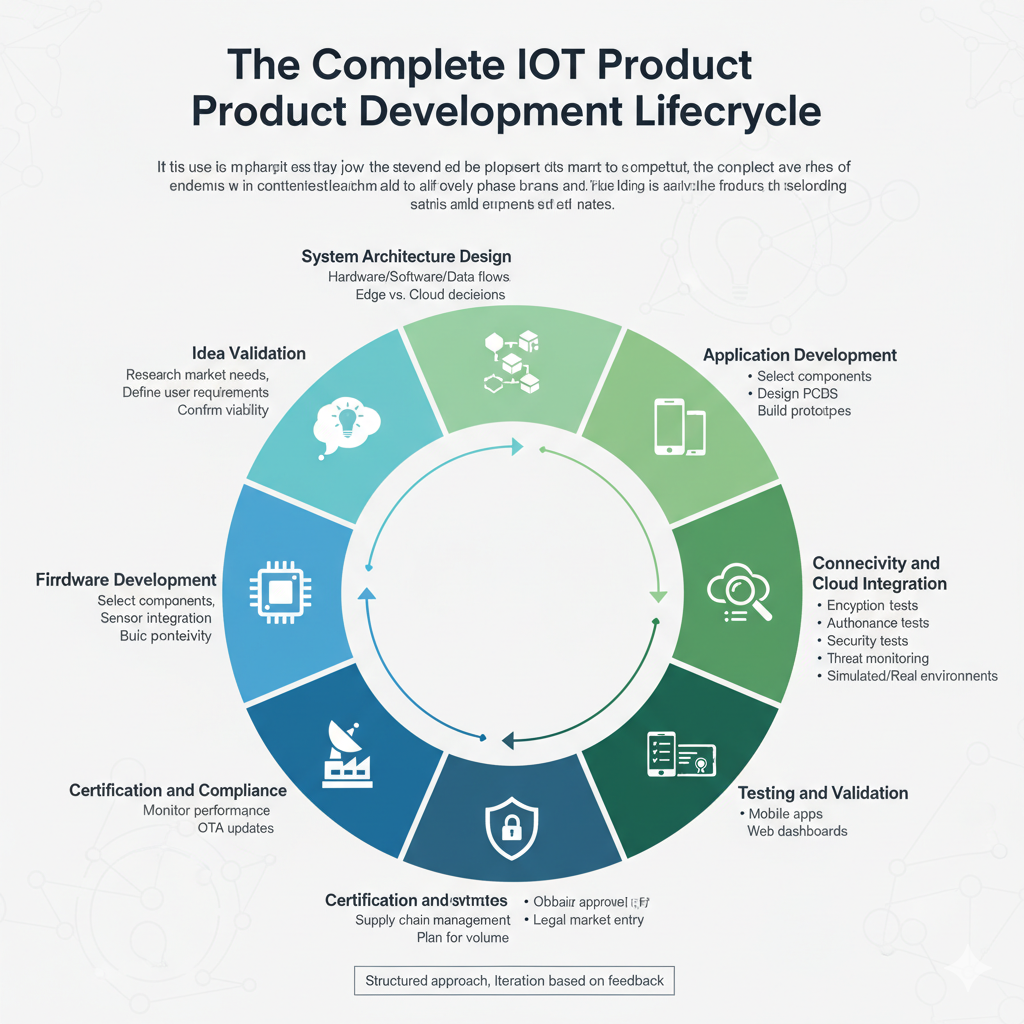
The IoT product development roadmap encompasses a comprehensive journey from conception to ongoing operations. This high-level overview outlines the key phases before delving into each in detail.
- Idea Validation: Research market needs, conduct feasibility studies, and define user requirements to confirm viability.
- System Architecture Design: Create block diagrams mapping hardware, software, and data flows, including edge vs. cloud decisions.
- Hardware Development: Select components, design PCBs, and build prototypes for physical functionality.
- Firmware Development: Write embedded code for device control, sensor integration, and basic connectivity.
- Connectivity and Cloud Integration: Implement protocols like MQTT and set up cloud services for data storage and processing.
- Application Development: Build user-facing interfaces, such as mobile apps or web dashboards, for system control.
- Security Implementation: Embed encryption, authentication, and threat monitoring across all layers.
- Testing and Validation: Perform functional, performance, and security tests in simulated and real environments.
- Certification and Compliance: Obtain necessary approvals like FCC, CE, or UL for legal market entry.
- Manufacturing and Scaling: Optimize for production, manage supply chains, and plan for volume increases.
- Deployment and Maintenance: Roll out to users, monitor performance, and enable OTA updates for longevity.
This structured approach ensures systematic progress while allowing iteration based on feedback.
IoT Product Lifecycle Explained
The IoT product lifecycle provides a framework for managing development from inception to retirement, ensuring sustainability and continuous improvement. It consists of five main stages, each with specific goals and activities.
Concept Stage
This initial phase focuses on ideation and validation. Begin by identifying market gaps through user research and competitor analysis. Develop high-level requirements, including key features and performance metrics. Conduct technical feasibility studies to assess hardware and software needs. Create initial wireframes or mockups to visualize the product. The goal is to build a business case, estimating potential ROI and risks. Common tools include SWOT analysis and customer interviews. By the end, you should have a validated concept document outlining the product’s value proposition.
Engineering and Development Stage
Here, the focus shifts to building the core system. Design detailed architecture, selecting microcontrollers like ESP32 for cost-effective Wi-Fi connectivity or STM32 for robust industrial applications. Develop firmware using C/C++ for low-level control, incorporating power management for battery-operated devices. Integrate cloud services such as AWS IoT Core for scalable data handling. Build prototypes using 3D printing for enclosures and breadboards for circuits. Iterate through agile sprints, testing subsystems for integration issues. This stage typically consumes 40-60% of the total timeline, emphasizing modular design for future upgrades.
Pre-Production Stage
Transition to manufacturability by refining designs for DFM (Design for Manufacturability). Conduct pilot runs of 50-500 units to validate assembly processes. Perform rigorous testing, including environmental stress tests for temperature and humidity resilience. Address compliance early, preparing for certifications like RoHS for environmental standards. Optimize BOM (Bill of Materials) to reduce per-unit costs, potentially switching to volume-optimized components. Gather beta user feedback to fine-tune user experience. This phase bridges development and scaling, identifying production bottlenecks.
Production Stage
Scale to full manufacturing with established suppliers. Implement quality control through automated testing jigs and statistical process control. Manage inventory using just-in-time principles to minimize holding costs. Roll out firmware management systems for initial provisioning. Monitor production yields, aiming for 95%+ efficiency. Coordinate logistics for global distribution if applicable. This stage requires close collaboration with contract manufacturers, using tools like ERP systems for tracking.
Post-Deployment Lifecycle
Ongoing maintenance ensures long-term success. Implement monitoring dashboards using tools like Grafana for real-time performance tracking. Enable OTA (Over-The-Air) updates for security patches and feature additions, potentially using protocols like MQTT for efficient delivery. Collect usage analytics to inform iterations. Plan for end-of-life, including secure data migration and recycling programs. Regular security audits prevent vulnerabilities. This phase can extend product life by 2-5 years through proactive management.
[Internal Link: IoT Product Lifecycle Explained]
Turning an Idea into an IoT System Architecture
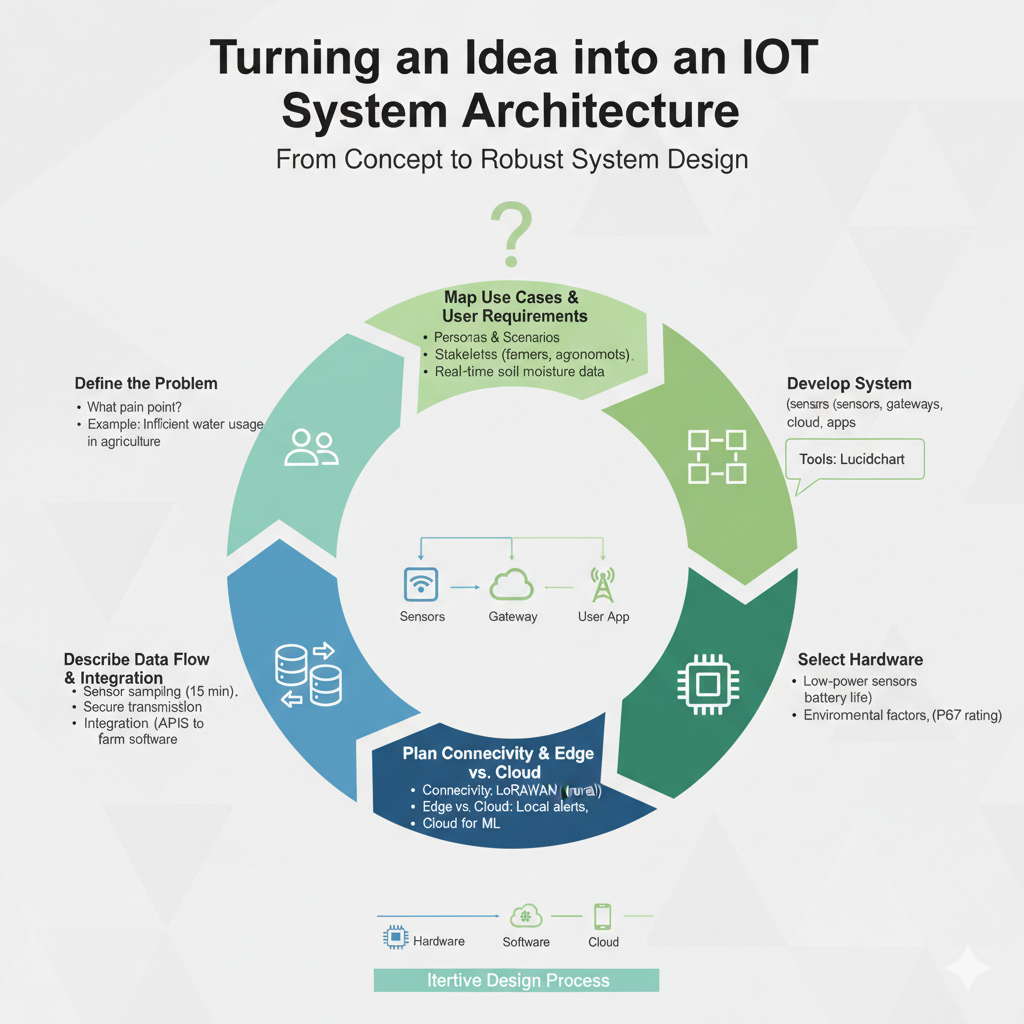
Transforming a raw concept into a robust IoT system requires methodical architecture design. Start by clearly defining the problem: What pain point does this solve? For instance, in agricultural monitoring, the issue might be inefficient water usage.
Map use cases and user requirements through personas and scenarios. Identify stakeholders—farmers, agronomists—and their needs, like real-time soil moisture data.
Develop system block diagrams showing components: sensors (moisture, temperature), gateways for data aggregation, cloud for analytics, and apps for visualization. Use tools like Lucidchart for diagramming.
Select hardware logically: Choose low-power sensors for battery life, considering environmental factors like IP67 rating for weather resistance.
Plan connectivity: LoRaWAN for long-range rural areas vs. Wi-Fi for urban settings. Evaluate edge vs. cloud: Process simple alerts locally to reduce latency, send aggregated data to cloud for ML-based predictions.
Describe data flow: From sensor sampling every 15 minutes, through secure transmission, to cloud storage in time-series databases like InfluxDB. Ensure integration with existing systems, perhaps via APIs to farm management software.
This foundation prevents costly redesigns later.
[Internal Link: TurniIoT Hardware vs Software vs Cloud – Role Breakdown
IoT success hinges on harmonious collaboration between hardware, software, and cloud components, each with distinct responsibilities.
Hardware handles physical interactions: sensors capture data (e.g., temperature via thermistors), actuators respond (e.g., motors adjust valves), and microcontrollers like ARM Cortex-M process locally. Responsibilities include power management and basic computation, requiring skills in electronics and PCB design.
Firmware bridges hardware and higher layers: Written in C for efficiency, it manages device boot, sensor reading, and initial data filtering. Key duties include error handling and OTA update support, demanding embedded systems expertise.
Cloud/backend manages scale: Services like Azure IoT Hub handle device registration, data ingestion, and analytics using tools like Apache Kafka for streaming. Responsibilities include storage in databases like MongoDB and API provision, needing cloud architecture and DevOps skills.
Applications deliver user value: Mobile/web interfaces using React Native visualize data and enable control. Duties include UX design for intuitive dashboards, requiring frontend development and UI/UX expertise.
Cross-functional teams map skills to roles: Hardware engineers focus on circuits, software developers on code, while product managers coordinate. Regular syncs ensure alignment.
[Internal Link: IoT Hardware vs Software vs Cloud – Role Breakdown]ng an Idea into an IoT System Architecture]
MVP Development Strategy for IoT Startups
In IoT, an MVP is a functional prototype demonstrating core value with minimal features, like a basic smart thermostat controlling temperature via app.
Rapid prototyping uses development boards (Raspberry Pi) for quick assembly, focusing on essential sensors and connectivity. Proof-of-concept validates technical feasibility, while market-ready prototypes add basic enclosure for user testing.
Validation involves beta deployments to gather feedback on usability and reliability. Iterate based on metrics like connection stability.
Avoid over-engineering: Skip advanced analytics in MVP; add later. This keeps costs low ($50,000-$150,000) and timeline short (3-6 months).
[Internal Link: MVP Development Strategy for IoT Startups]
Cost Estimation and BOM Planning for IoT Products
Creating a BOM lists all components: MCU ($5-20), RF modules ($10-50), PCB ($2-10 per unit in volume), enclosure ($5-15). Use tools like Octopart for pricing.
Major cost drivers: High-end MCUs for processing, RF for connectivity (e.g., cellular vs. Wi-Fi), certification ($10,000-50,000 per standard).
Hidden costs: Cloud ($0.01/GB storage + compute), maintenance (firmware updates), tooling ($20,000 for injection molds).
Development ($100,000-500,000) vs. per-unit ($20-100 at scale). Optimize: Standardize components, design for assembly, negotiate volume discounts.
[Internal Link: Cost Estimation and BOM Planning for IoT Products]
Scaling from Prototype to Production
Design revisions for manufacturability: Simplify PCBs, use SMT components.
DFM considerations: Minimize vias, ensure trace widths for current.
Supply chain planning: Diversify suppliers, forecast demand.
Production firmware: Version control with Git, automated builds.
Testing automation: Jigs for functional checks, quality control via Six Sigma.
[Internal Link: Scaling from Prototype to Production]
IoT Product Certification and Compliance Overview
Regulatory certifications: CE (EU safety), FCC (US RF emissions).
EMC/RF compliance: Test for interference using anechoic chambers.
Safety standards: UL for electrical safety.
Early decisions like component selection affect success—use pre-certified modules to speed process.
[Internal Link: IoT Product Certification and Compliance Overview]
Common Mistakes in IoT Product Development
Ignoring security: Always implement encryption from day one.
Underestimating cloud costs: Monitor usage with tools like AWS Cost Explorer.
Poor power design: Optimize for low consumption to extend battery life.
No OTA strategy: Plan for remote updates to fix issues post-deployment.
Weak documentation: Use version control and wikis for team knowledge.
Skills Required for IoT Product Development Teams
Embedded systems: C programming for firmware.
PCB design: Tools like Altium for layouts.
Firmware engineering: RTOS like FreeRTOS.
Cloud architecture: AWS/Azure expertise.
Cybersecurity: Encryption protocols.
Product management: Agile methodologies.
Recommended Tools and Technology Stack
Microcontrollers: ESP32 (Wi-Fi/BLE), STM32 (industrial).
Protocols: MQTT (messaging), HTTP (web), CoAP (constrained devices).
Cloud platforms: AWS IoT, Azure IoT.
PCB tools: KiCad (free), Altium (professional).
Version control: Git.
FAQ
What is the first step in IoT product development?
Idea validation through market research and feasibility studies.
How long does IoT prototype development take?
Typically 1-3 months for a basic MVP.
What are key IoT security considerations?
Implement end-to-end encryption and regular audits.
How to estimate IoT hardware costs?
Create a detailed BOM and factor in volume discounts.
What certifications are needed for IoT products?
FCC/CE for RF, UL for safety, depending on market.
Why is MVP important for IoT startups?
It validates concepts with minimal investment.
How to scale IoT from prototype to production?
Focus on DFM and supply chain optimization.
Conclusion
The complete IoT product development roadmap demands systematic planning from idea validation to maintenance, emphasizing integrated hardware-software-cloud design. System-level thinking is crucial for overcoming complexity and delivering value. Explore linked cluster articles for deeper insights. As a trusted authority in IoT, we guide builders toward successful, scalable solutions.