
Introduction
In the ever-evolving world of logistics and supply chain operations, mobile robots have emerged as game-changers, automating tasks that once relied heavily on manual labor. At the heart of this transformation are Autonomous Mobile Robots (AMRs), intelligent systems capable of navigating warehouse environments independently, without the need for predefined paths or human intervention. These robots use advanced sensors and AI to transport goods, manage inventory, and optimize workflows, making them essential for modern warehouse management.
AMRs are transforming warehouse management by addressing critical pain points such as labor shortages, operational inefficiencies, and the demand for faster order fulfillment in e-commerce. As businesses strive for greater agility in a post-pandemic economy, AMRs enable seamless scaling, reduce errors, and enhance overall productivity. Whether in large distribution centers or smaller fulfillment hubs, these robots integrate with existing systems to create smarter, more responsive operations. [Internal Link: Overview of Warehouse Automation]
This pillar guide delves deep into the role of AMRs in warehouse automation, covering their technologies, applications, and future potential. By focusing on practical insights and real-world examples, we’ll show how adopting these mobile robots can drive competitive advantages in intralogistics.
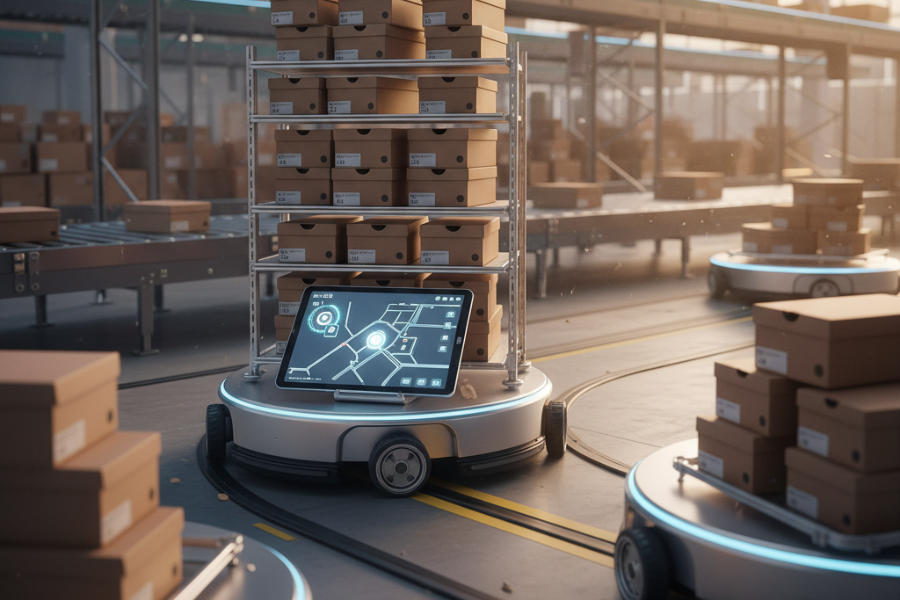
What Are Autonomous Mobile Robots (AMRs)?
Autonomous Mobile Robots (AMRs) are self-guided vehicles designed for dynamic environments like warehouses, where they perform tasks such as material transport, order picking, and inventory management. Unlike traditional Automated Guided Vehicles (AGVs) that follow fixed tracks, AMRs use onboard intelligence to adapt to changes in real-time, ensuring flexibility in unpredictable settings.
Working Principle
The core working principle of AMRs revolves around perception, planning, and execution. They perceive their surroundings through sensors, plan optimal paths using algorithms, and execute movements with precision. For instance, if a worker blocks a route, an AMR can reroute instantly without halting operations. This autonomy stems from sophisticated software that processes environmental data continuously, allowing robots to collaborate with humans and other machines in shared spaces.
Key Technologies
Several cutting-edge technologies enable AMRs to function effectively:
- AI and Machine Learning: These allow robots to learn from past interactions, predict obstacles, and optimize routes for efficiency. AI-driven decision-making ensures AMRs handle complex tasks like multi-robot coordination in busy warehouses.
- SLAM (Simultaneous Localization and Mapping): SLAM technology creates and updates digital maps of the warehouse in real-time, enabling precise navigation even in changing layouts.
- LiDAR and Vision Systems: LiDAR uses laser pulses to measure distances and build 3D models of the environment, while computer vision cameras identify objects, read barcodes, and detect hazards.
- Sensors: A suite of ultrasonic, infrared, and inertial sensors provides data on proximity, speed, and orientation, enhancing safety and accuracy.
These technologies make AMRs versatile for various warehouse scenarios, from high-density storage to fast-paced picking zones.
Industry definition or robotics standards source
Why Warehouses Are Adopting AMRs
The adoption of Autonomous Mobile Robots in warehouses is accelerating due to their ability to solve longstanding challenges in logistics. With global supply chains under pressure from e-commerce growth and workforce constraints, AMRs offer a reliable path to automation without massive infrastructure overhauls.
Efficiency
AMRs boost efficiency by automating repetitive tasks, such as transporting goods across vast warehouse floors. They can operate 24/7, reducing cycle times and increasing throughput by up to 300% in order fulfillment processes. For example, in goods-to-person systems, robots deliver items directly to workers, minimizing travel time and fatigue.
Scalability
One of the standout advantages of AMRs is their scalability. Warehouses can deploy additional robots during peak seasons like holidays without redesigning layouts, unlike fixed systems. This modular approach allows small operations to start with a few units and expand as needed, supporting business growth seamlessly.
Cost Reduction
By reducing reliance on manual labor, AMRs lower operational costs significantly—often by 30-50% through decreased overtime and error-related losses. Initial investments are offset by long-term savings in maintenance and energy, making them accessible even for mid-sized facilities.
Safety and Human-Robot Collaboration
Safety is paramount in warehouse environments, and AMRs enhance it with built-in collision avoidance and emergency stop features. They promote human-robot collaboration, where workers focus on high-value tasks while robots handle heavy lifting, reducing injury rates by up to 70%. This symbiotic relationship fosters a safer, more productive workspace. [Internal Link: Benefits of Warehouse Automation]
Goods-to-Person Robots
Goods-to-person robots represent a specialized application of Autonomous Mobile Robots, where shelves or bins are transported directly to human operators for picking, eliminating the need for workers to traverse aisles.
These systems work by AMRs lifting and moving storage units to ergonomic stations, guided by AI-optimized paths. Integration with warehouse management software ensures the right items arrive just in time for orders.
Commercial warehouse use cases include e-commerce giants like Amazon, where goods-to-person AMRs handle millions of items daily in fulfillment centers, streamlining operations during high-demand periods.
Benefits:
- Dramatically increases pick rates, often doubling or tripling productivity.
- Reduces physical strain on workers, leading to lower turnover.
- Enhances accuracy by minimizing manual searches.
Limitations:
- Requires compatible racking systems, which may involve upfront retrofitting.
- Less effective for very large or irregularly shaped items that don’t fit standard bins.
Detailed Guide on Goods-to-Person Robots
Commercial AMR Solution Example
Pallet Transport Robots
Pallet transport robots are heavy-duty AMRs designed to move loaded pallets efficiently across warehouse zones, automating what was traditionally forklift territory.
They operate using lifting forks or platforms, navigating via SLAM and LiDAR to avoid obstacles while carrying loads up to 2,000 kg. Fleet management software coordinates multiple units for synchronized transport.
In commercial settings, companies like Walmart utilize pallet transport AMRs in distribution centers to replenish stock from receiving docks to storage areas, ensuring continuous flow.
Benefits:
- Improves safety by replacing manual forklifts, reducing accident risks.
- Offers high payload capacity for bulk handling, boosting throughput.
- Enables flexible routing in dynamic layouts without fixed infrastructure.
Limitations:
- Demands even flooring to prevent tipping; uneven surfaces can limit deployment.
- Higher energy consumption for heavy loads may increase operational costs in large-scale use.
Detailed Guide on Pallet Transport Robots
Commercial AMR Solution Example
Inventory Handling Robots
Inventory handling robots leverage AMRs to automate stock monitoring, counting, and reorganization, providing real-time visibility into warehouse assets.
These robots scan shelves using RFID or vision systems while moving autonomously, updating inventory databases instantly to prevent stockouts or overstocking.
Real-world applications include DHL’s global warehouses, where inventory handling AMRs conduct cycle counts overnight, maintaining accuracy without disrupting daytime operations.
Benefits:
- Achieves near-perfect inventory accuracy, often 99% or higher.
- Frees up staff for strategic tasks, reducing labor allocation to audits.
- Supports predictive analytics for better demand forecasting.
Limitations:
- Relies on consistent tagging; incompatible items require manual intervention.
- Initial mapping and integration can be time-consuming in complex environments.
Detailed Guide on Inventory Handling Robots
Commercial AMR Solution Example
Order Picking Robots
Order picking robots, powered by AMRs, assist in selecting items for customer orders, using robotic arms or simple transport to gather products efficiently.
They follow optimized paths generated by AI, collaborating with human pickers in hybrid models or operating fully autonomously in advanced setups.
Alibaba’s smart warehouses exemplify this, with order picking AMRs processing thousands of e-commerce orders daily, integrating voice-guided systems for precision.
Benefits:
- Speeds up fulfillment, cutting order cycle times by 40-60%.
- Handles variable SKUs with ease, adapting to seasonal changes.
- Minimizes picking errors through barcode verification.
Limitations:
- Struggles with delicate or non-standard items without advanced grippers.
- Requires ongoing software updates to handle new product lines.
Detailed Guide on Order Picking Robots
Commercial AMR Solution Example
Material Handling Automation
Material handling automation encompasses broad AMR applications for moving raw materials, components, or finished goods within warehouses.
AMRs in this role use modular attachments for versatility, coordinating via central software to streamline flows from inbound to outbound.
FedEx employs material handling AMRs in sorting facilities to automate package routing, enhancing speed in high-volume logistics hubs.
Benefits:
- Reduces handling times by automating repetitive transfers.
- Integrates seamlessly with other automation for end-to-end efficiency.
- Lowers damage rates through gentle, controlled movements.
Limitations:
- High initial costs for fleet deployment in large warehouses.
- Dependency on reliable Wi-Fi for real-time communication.
Detailed Guide on Material Handling Automation
Commercial AMR Solution Example
Last-Mile Warehouse Automation
Last-mile warehouse automation focuses on the final stages of order preparation, using AMRs for sorting, packing, and loading to bridge warehouse and delivery.
These robots sort parcels by destination, optimizing loading sequences for trucks or drones.
UPS uses last-mile AMRs in urban fulfillment centers to prepare packages for same-day delivery, minimizing delays in dense markets.
Benefits:
- Accelerates outbound processes, improving delivery timelines.
- Reduces errors in labeling and routing.
- Scales easily for peak e-commerce demands.
Limitations:
- Space constraints in smaller warehouses limit robot numbers.
- Integration with external carriers requires custom APIs.
Detailed Guide on Last-Mile Warehouse Automation
Commercial AMR Solution Example
Intralogistics Robots
Intralogistics robots manage internal material flows, with AMRs ensuring efficient movement between production, storage, and shipping zones.
They employ AI for traffic management, avoiding bottlenecks in multi-zone operations.
Siemens integrates intralogistics AMRs in manufacturing-linked warehouses for just-in-time parts delivery, supporting lean operations.
Benefits:
- Enhances traceability with real-time tracking.
- Supports Industry 4.0 connectivity for data-driven decisions.
- Reduces internal transport costs by optimizing routes.
Limitations:
- Complex in multi-level facilities; elevators add navigation challenges.
- Software vulnerabilities could disrupt coordinated fleets.
Detailed Guide on Intralogistics Robots
Commercial AMR Solution Example
Warehouse Picking and Sorting Robots
Warehouse picking and sorting robots automate the selection and classification of items, using AMRs equipped with manipulators for high-speed processing.
They sort by size, weight, or destination, often in conveyor-hybrid systems.
Ocado’s automated grocery warehouses deploy these AMRs to handle diverse products, achieving rapid sorting for online orders.
Benefits:
- Quadruples sorting speeds compared to manual methods.
- Handles mixed loads efficiently, reducing waste.
- Improves order accuracy in high-variety environments.
Limitations:
- Fragile items may require specialized end-effectors.
- Maintenance for mechanical arms increases downtime risks.
Detailed Guide on Warehouse Picking and Sorting Robots
Commercial AMR Solution Example
Mobile Robots vs Conveyor Systems
When evaluating warehouse automation options, comparing mobile robots like AMRs to traditional conveyor systems is crucial. AMRs provide dynamic flexibility, while conveyors excel in fixed, high-throughput scenarios. Below is a detailed comparison table highlighting key factors.
| Aspect | Mobile Robots (AMRs) | Conveyor Systems |
|---|---|---|
| Cost | Moderate initial investment; lower long-term due to scalability | High upfront costs for installation; fixed expenses |
| Flexibility | High; easily reconfigurable for layout changes | Low; requires major redesigns for modifications |
| Scalability | Excellent; add robots as needed without downtime | Limited; expansions involve significant infrastructure |
| Maintenance | Software-centric; predictive diagnostics reduce issues | Mechanical-heavy; frequent part replacements needed |
| Deployment Time | Quick; days to weeks with minimal disruption | Lengthy; months for custom builds and testing |
For more details in this regard you may visit here https://robologicslab.com/mobile-robots-vs-conveyor-systems-in-warehouse-management/
This comparison underscores AMRs’ advantages in adaptable environments. Warehouse Automation Comparison Study
Business & Commercial Perspective
From a business lens, Autonomous Mobile Robots deliver tangible value through strategic investments that align with long-term goals.
ROI of Autonomous Mobile Robots
ROI for AMRs is typically realized within 12-24 months, driven by labor savings, reduced errors, and increased throughput. For instance, a mid-sized warehouse might save $500,000 annually by automating picking, with payback accelerated by tax incentives for automation.
Scalability for Small and Large Warehouses
AMRs scale effortlessly: small warehouses start with entry-level fleets, while large ones deploy hundreds for peak handling. This flexibility supports growth without proportional cost increases.
Integration with WMS and ERP Systems
Seamless integration via APIs allows AMRs to sync with Warehouse Management Systems (WMS) and Enterprise Resource Planning (ERP) for real-time data exchange, optimizing inventory and orders. [Internal Link: Warehouse Management Systems Explained]
AI, Smart Warehouses & Future Trends
AI is elevating AMRs to new heights, fostering smart warehouses where robots anticipate needs and self-optimize.
AI-Powered Fleet Management
AI algorithms manage AMR fleets by predicting traffic, assigning tasks dynamically, and minimizing energy use, ensuring peak efficiency.
Smart Intralogistics
In smart warehouses, AMRs integrate with IoT for predictive maintenance and adaptive workflows, reducing downtime.
Industry 4.0 Relevance
AMRs are central to Industry 4.0, enabling connected, resilient supply chains with data analytics for continuous improvement.
FAQs
What are Autonomous Mobile Robots (AMRs) in warehouse management?
Autonomous Mobile Robots (AMRs) are AI-driven vehicles that navigate warehouses independently to transport goods, pick orders, and manage inventory. They use sensors like LiDAR for real-time mapping, improving efficiency and safety without fixed paths. Ideal for dynamic environments, AMRs adapt to changes seamlessly.
How do AMRs differ from AGVs?
AMRs operate autonomously with AI and sensors for flexible navigation, while AGVs follow predetermined paths like magnetic tapes. This makes AMRs more adaptable to warehouse changes, reducing setup costs and enhancing scalability for modern logistics needs.
What benefits do AMRs provide for warehouse efficiency?
AMRs enhance efficiency by automating material transport, reducing worker travel time, and increasing throughput by 200-300%. They minimize errors, operate 24/7, and integrate with systems for optimized workflows, leading to cost savings and faster order fulfillment.
Are AMRs safe for human-robot collaboration in warehouses?
Yes, AMRs prioritize safety with obstacle detection via LiDAR and cameras, automatic slowing, and emergency stops. They enable collaborative zones where humans and robots work together, cutting injury rates by up to 70% in shared spaces.
What is the future of AMRs in smart warehouses?
The future involves AI advancements for predictive analytics, swarm robotics for fleet coordination, and Industry 4.0 integration. AMRs will enable fully autonomous warehouses with IoT connectivity, driving sustainability and hyper-efficiency in global supply chains.
Conclusion
In summary, Autonomous Mobile Robots (AMRs) are pivotal in advancing warehouse management, offering unparalleled efficiency, scalability, and safety across applications like goods-to-person systems, pallet transport, and order picking. By outperforming traditional methods like conveyors in flexibility and ROI, AMRs empower businesses to meet rising demands in e-commerce and logistics.
As technology evolves, AMRs will further integrate with AI and smart systems, ushering in an era of fully optimized intralogistics. Embracing these innovations is key to future-proofing operations. [Internal Link: Getting Started with Warehouse Robotics]
Ready to revolutionize your warehouse? Explore AMR solutions today and consult with robotics experts for a tailored implementation plan.