
Robotics is no longer a futuristic fantasy; it’s a rapidly evolving field shaping our present and defining our future. From automated manufacturing to intelligent assistants, robots are becoming integral to our lives. This makes equipping the next generation with the knowledge and skills to understand, design, and innovate in robotics not just an advantage, but a necessity. So, how do we craft a compelling and effective curriculum for robotics education?
It all starts with a clear vision.
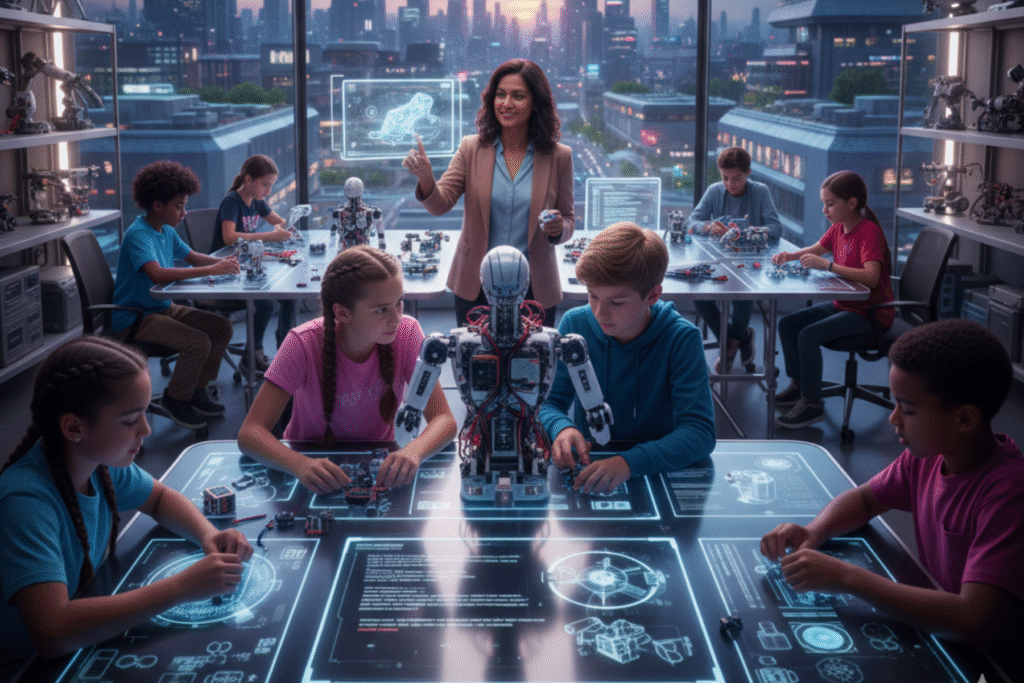
Define Your “Why” and “Who”
Before diving into specific topics, ask yourself:
- What are the primary goals? Are you aiming for foundational literacy, preparing students for specific career paths, fostering problem-solving skills, or inspiring future engineers?
- Who are your learners? Are they elementary school students, high schoolers, undergraduates, or adult learners? Their age, prior knowledge, and learning styles will heavily influence your approach.
For instance, an elementary school program might focus on playful exploration and basic concepts like movement and sensors, while a high school curriculum could delve into programming languages, circuit design, and more complex robot mechanisms.
Embrace a Hands-On, Project-Based Approach
Robotics is inherently practical. Students learn best by doing, building, and experimenting.
- Start simple: Begin with pre-made kits and guided projects that allow students to quickly see their ideas come to life.
- Encourage iterative design: Teach them that failure is a learning opportunity. Prototypes rarely work perfectly the first time.
- Integrate real-world challenges: Present problems that robots could solve, like sorting objects, navigating mazes, or performing simple tasks.
This approach not only makes learning engaging but also develops critical thinking, teamwork, and resilience.
Core Components of a Robust Robotics Curriculum
While the depth will vary, a comprehensive robotics curriculum generally covers these key areas:
- Mechanics and Design:
- Basic structural components (frames, wheels, gears)
- Motors and actuators (how robots move)
- Sensors (how robots perceive their environment – light, touch, ultrasonic, IR)
- CAD software for designing robot parts (for older students)
- Electronics:
- Basic circuits and components (resistors, LEDs, breadboards)
- Microcontrollers (e.g., Arduino, Raspberry Pi)
- Wiring and power management
- Programming and Control:
- Introduction to programming logic (flowcharts, pseudocode)
- Block-based programming (Scratch, Blockly) for beginners
- Text-based programming (Python, C++) for more advanced learners
- Algorithms for robot behavior (line following, obstacle avoidance)
- Systems Integration:
- Understanding how all the components (mechanics, electronics, software) work together as a cohesive system.
- Troubleshooting and debugging skills.
Integrate STEM & Beyond
Robotics is a fantastic vehicle for integrating various subjects:
- Science: Physics (forces, motion, electricity), biology (bio-inspired robotics)
- Technology: Engineering design process, digital fabrication
- Engineering: Problem-solving, design, construction
- Mathematics: Geometry, algebra, data analysis
Don’t forget the “A” in STEAM (Arts)! Encourage creativity in robot design and application. Furthermore, discussions around the ethics and societal impact of AI and robotics are crucial for developing responsible innovators.
Leverage Resources and Community
You don’t have to reinvent the wheel. Many excellent resources exist:
- Robotics Kits: LEGO Mindstorms, VEX Robotics, Arduino kits, micro:bit.
- Online Tutorials: YouTube channels, specialized robotics websites.
- Competitions: FIRST Robotics, VEX Robotics Competition, RoboCup Junior. These provide excellent motivation and a platform for students to apply their skills.
- Industry Partnerships: Connect with local engineering firms or universities for guest speakers, mentors, or field trips.
Continuous Evaluation and Adaptation
The field of robotics is constantly evolving, and so should your curriculum.
- Gather feedback: Regularly solicit input from students, teachers, and industry professionals.
- Assess learning: Beyond project completion, evaluate problem-solving skills, collaboration, and critical thinking.
- Stay current: Be prepared to update content, tools, and methodologies as new technologies emerge.
Conclusion
Developing a robotics education curriculum is an exciting and impactful endeavor. By focusing on hands-on learning, a well-rounded set of core competencies, interdisciplinary connections, and a willingness to adapt, we can empower students to become the innovators who will build a smarter, more automated, and more exciting future. Let’s inspire the next generation of roboticists!