
Building the Foundation for a Successful School Robotics Program
Building the Foundation for a Successful School Robotics Program
Starting a school robotics program requires careful planning. Begin with a thorough needs assessment that inventories your current technology resources, available classroom space, and existing infrastructure like reliable internet connectivity and sufficient power outlets. Take stock of staff expertise—you might already have teachers with programming experience or engineering backgrounds who could champion your initiative.
Next, establish clear educational goals that align with your school’s curriculum standards. For elementary schools, focus on basic programming concepts and simple machine building. Middle schools might emphasize more complex programming and engineering design principles. High schools can integrate advanced concepts like artificial intelligence or autonomous systems. The International Society for Technology in Education (ISTE) offers frameworks to help align robotics with computational thinking standards.
Develop a realistic implementation timeline. Most successful programs start small—perhaps with an after-school club or a single grade level—before expanding. Your roadmap might look like:
- Year 1: Pilot program with one grade level
- Year 2: Expand to additional grades and integrate with science curriculum
- Year 3: Establish competition teams and cross-curricular integration
Finally, create metrics to measure success. Beyond student participation numbers, consider tracking:
- Student growth in specific STEM concepts
- Changes in attitudes toward technology careers
- Development of teamwork and problem-solving skills
- Increased engagement from traditionally underrepresented groups in STEM
Selecting Age-Appropriate Robotics Platforms and Equipment
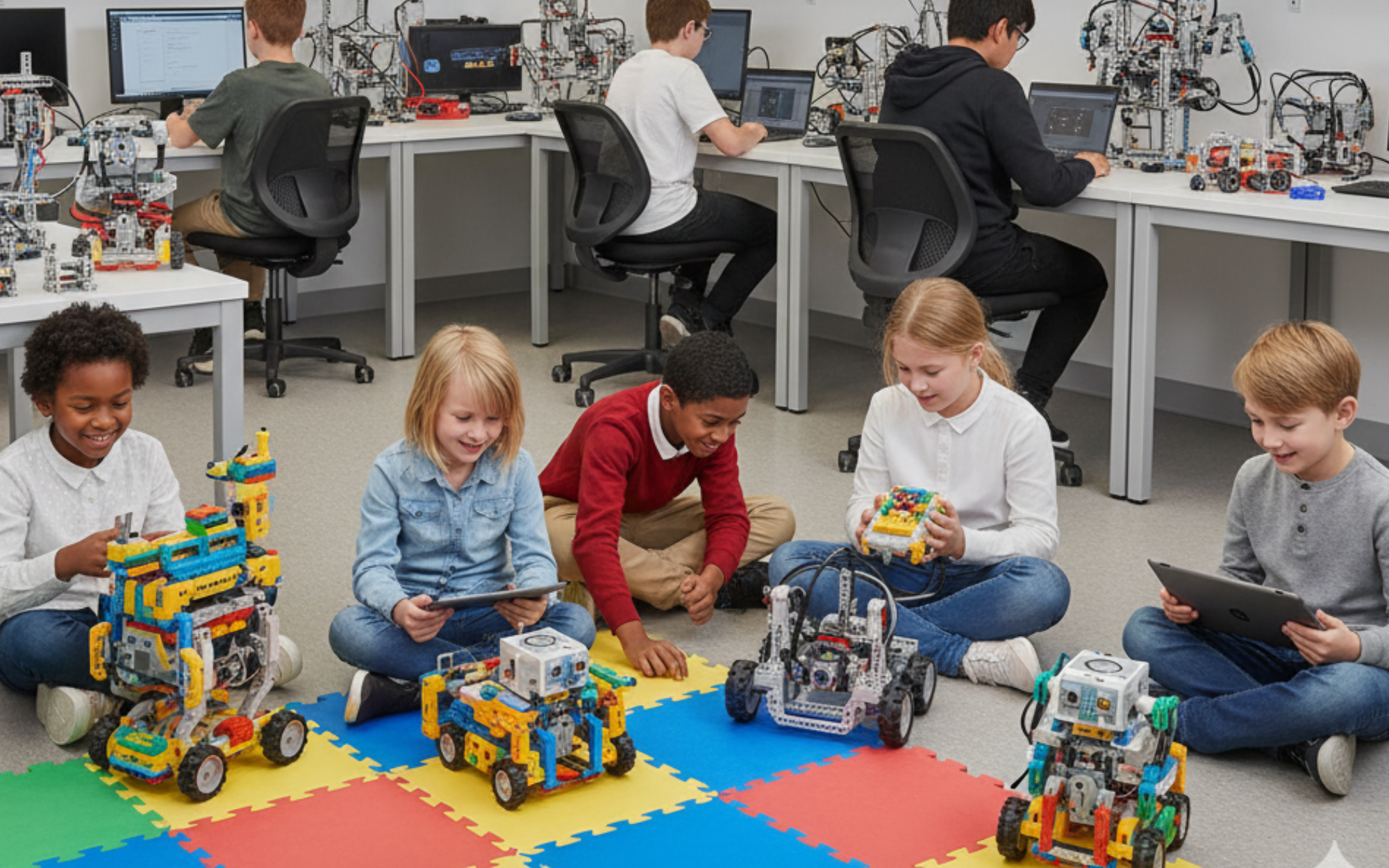
Choosing the right robotics platform dramatically impacts student engagement and learning outcomes. For elementary students, colorful, intuitive platforms like LEGO WeDo provide a block-based programming interface and simple construction. Dash & Dot robots offer instant feedback with their mobility and sensors, while Bee-Bots teach basic sequencing without screens.
Middle schoolers benefit from more complex systems. LEGO Mindstorms combines familiar building blocks with expanded programming capabilities. VEX IQ introduces metal components and gear systems, while micro:bit offers an affordable entry into physical computing with its compact microcontroller.
High school programs should consider industry-relevant platforms.
VEX EDR supports sophisticated mechanical designs for competition-level robotics. Arduino provides extensive sensor integration possibilities, and Raspberry Pi combines computing power with physical control systems that mirror professional applications.
When selecting equipment, consider:
- Initial cost vs. longevity (cheaper isn’t always better if replacements are needed yearly)
- Expandability through additional sensors or components
- Availability of curriculum resources and online communities
- Storage requirements and part replacement policies
The Robotics Education & Competition Foundation provides comprehensive comparisons of educational robotics systems to help inform your decision.
Budgeting and Funding Strategies for Robotics Education
Establishing a sustainable robotics program requires careful financial planning. Create a comprehensive budget that includes:
- Initial equipment purchases ($2,000-$10,000 depending on program size)
- Annual replacement parts (typically 10-15% of initial investment)
- Competition registration fees ($75-$5,000 depending on competition level)
- Travel expenses for competitions
- Professional development for teachers
- Dedicated storage solutions
Don’t let budget constraints stop your program before it starts. Federal funding sources like the Perkins V grant support career-technical education initiatives. Many states offer STEM-specific education grants, while organizations like FIRST Robotics maintain extensive grant databases for school robotics programs.
Local technology companies often welcome sponsorship opportunities that connect them with future talent. Create sponsorship packages with different contribution levels and recognition benefits. Some companies may offer employee volunteers alongside financial support.
Community funding can also play a crucial role. Parent-teacher organizations might dedicate fundraising events specifically to robotics. Crowdfunding platforms like DonorsChoose allow teachers to reach broader audiences, especially when campaigns highlight specific student benefits and include compelling videos of existing technology activities.
Creating Dedicated Spaces for Robotics Learning
The physical environment significantly impacts robotics education success.
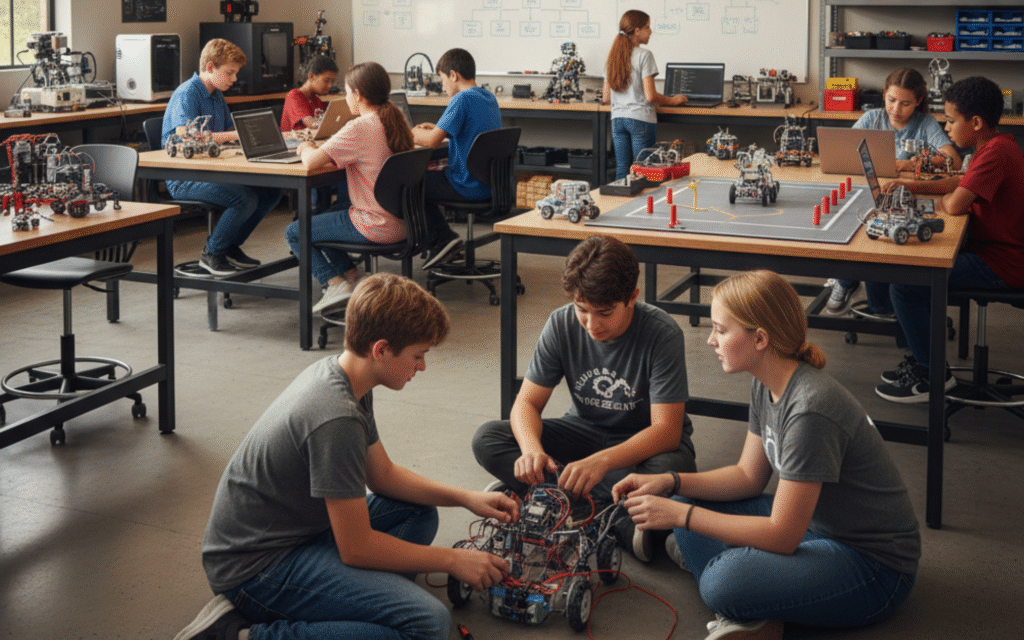
Permanent robotics labs offer stability with dedicated workbenches, proper electrical outlets, projection capabilities, and secure storage. However, when space is limited, mobile robotics carts provide flexibility—allowing any classroom to transform temporarily into a robotics workshop.
Effective storage solutions protect your investment and teach students responsibility. Consider:
- Clear plastic bins with labeled compartments for small parts
- Rolling cabinet systems with lockable doors
- Student check-out systems for accountability
- Digital inventory management for tracking components
Safety must remain paramount. Establish protocols for tool usage, electrical safety, and proper handling of components. Classroom management strategies might include designated team roles, visual cues for transitioning between activities, and cleanup procedures.
For schools with limited resources, multi-purpose space planning can maximize utility. Tables with whiteboard surfaces serve both robotics construction and traditional classwork. Flexible seating arrangements accommodate both collaborative project work and direct instruction. Wall-mounted pegboards provide vertical storage while showcasing student projects.
Teacher Professional Development and Support Systems
Even the most well-equipped robotics lab falls short without properly prepared teachers. Identify core competencies your robotics educators need:
- Basic programming concepts and specific platform knowledge
- Engineering design process familiarity
- Project-based learning facilitation skills
- Assessment strategies for hands-on technology work
Numerous organizations offer teacher training specific to educational robotics. Platform manufacturers typically provide online courses, while regional training centers like the Carnegie Science Center offer in-person workshops with hands-on experience.
Building internal capacity ensures program sustainability. Consider sending 2-3 teachers to intensive training who then return to train colleagues. Establish mentorship pairs between technology-comfortable teachers and those still building confidence.
Create a professional learning community dedicated to robotics education, meeting regularly to share successes, troubleshoot challenges, and plan curriculum integration. This community might extend beyond your school through online forums or regional teacher networks, providing broader perspective and shared resources.
Implementing and Sustaining Effective Robotics Curriculum
Integrating Robotics Across Core Subject Areas
Robotics offers a perfect vehicle for cross-curricular learning. In mathematics, students naturally apply geometric principles when designing robot structures and calculating movement paths. Middle schoolers can use proportional reasoning to adjust motor power ratios, while high schoolers can implement algebraic functions to create complex autonomous behaviors.
Science integration happens organically through engineering challenges. When students build robots that can climb inclines, they’re simultaneously investigating friction, gravity, and mechanical advantage.
These hands-on experiences make abstract physics concepts tangible. According to the Next Generation Science Standards, engineering practices should be embedded throughout science education—robotics provides this seamless connection.
Computational thinking doesn’t belong solely in computer science classes. When students decompose complex robot tasks into manageable steps, they’re developing algorithmic thinking that transfers across subjects. Elementary students can begin with visual block programming while older students progress to text-based languages, building foundations for sequential logic used in all disciplines.
Language arts skills flourish when students document their robotics work. Technical writing becomes necessary as teams create engineering notebooks, develop presentations for judges, and craft instructions for others to follow. One effective approach is having students create video tutorials explaining their robot design choices, simultaneously developing communication skills and technical vocabulary.
Structured Curriculum Options vs. Open-Ended Exploration
Pre-packaged robotics curricula offer significant advantages for teachers new to the field. Programs like LEGO Education’s SPIKE Prime provide comprehensive lesson plans aligned with learning standards, reducing planning time and ensuring proper skill progression. These structured approaches typically include built-in assessments and differentiation strategies.
However, the International Technology and Engineering Educators Association emphasizes that student-led inquiry leads to deeper understanding. Open-ended challenges like “design a robot that can sort recycling materials” allow students to develop creative problem-solving skills while applying technical knowledge to real-world problems.
The most successful programs blend both approaches. Begin with structured lessons to build foundational skills, then gradually release responsibility to students through increasingly open-ended challenges. This scaffolded approach accommodates diverse learning needs—providing additional structure for students requiring more support while allowing advanced students to extend their learning through self-directed exploration.
Effective differentiation in robotics education means varying not just the challenge complexity but also team roles. Creating specialized positions (mechanical engineer, programmer, project manager) allows students to contribute through their strengths while developing in areas needing growth.