
Introduction: Unlock Your Academic Potential
Are you constantly asking yourself, “How can I get smarter in school?” You’re not alone. Many students feel overwhelmed by the sheer volume of information and the pressure to perform. The good news? Getting smarter isn’t just about raw intelligence; it’s about employing effective learning strategies. This isn’t about studying harder, but about studying smarter. We’ll delve into 10 practical and proven techniques designed to transform your academic journey.
Let’s face it: the traditional methods of rote memorization often fall short. To truly excel, you need to understand how your brain learns best. This post will be your ultimate guide to unlocking your potential and seeing significant improvements in your grades and overall comprehension.
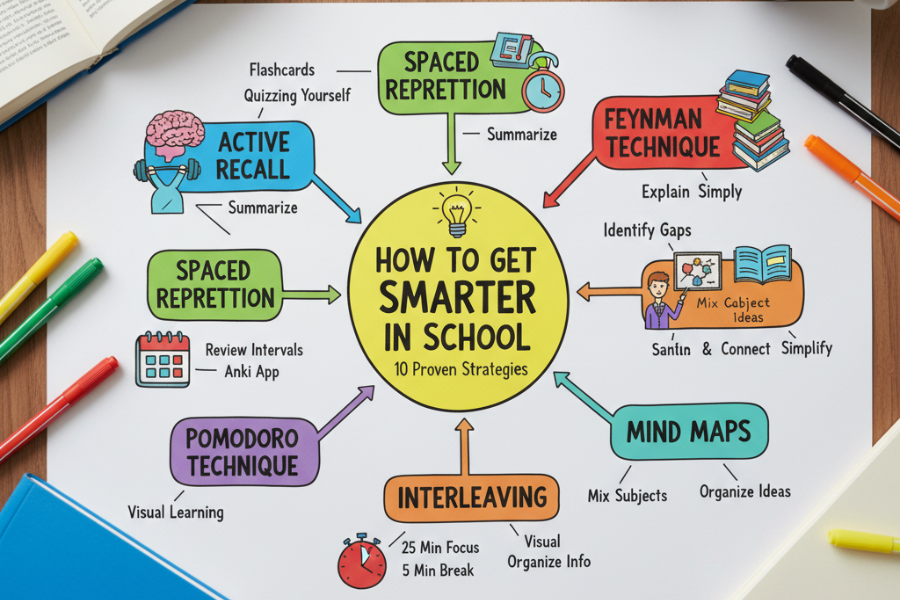
1. Master Active Recall: The Power of Remembering
One of the most effective strategies for how to get smarter in school is active recall. Instead of passively re-reading notes, challenge yourself to retrieve information from memory. This process strengthens neural pathways, making it easier to recall information later.
How to implement:
- After reading a chapter, close your book and try to summarize the key points aloud.
- Use flashcards, but instead of just reading them, try to explain the concept on the other side.
- Create practice questions for yourself and answer them without looking at your notes.
This method actively engages your brain. It forces you to think deeply about the material.
2. Embrace Spaced Repetition: The Anti-Forgetfulness Technique
Have you ever crammed for an exam, only to forget everything a week later? Spaced repetition is the antidote. It involves reviewing information at increasing intervals over time. This technique leverages the “forgetting curve” to ensure long-term retention.
Here’s how it works:
- Review new material shortly after learning it.
- Review it again a day later.
- Then, a few days later, a week later, and so on.
Tools like Anki can automate this process, making it incredibly efficient. This strategy is crucial for truly understanding how to get smarter in school.
3. Utilize the Feynman Technique: Learn by Teaching
The Nobel Prize-winning physicist Richard Feynman once said, “The first principle is that you must not fool yourself—and you are the easiest person to fool.” The Feynman Technique is about stripping away jargon and explaining complex concepts simply.
Steps to apply it:
- Choose a concept you want to understand.
- Pretend you are teaching it to someone with no prior knowledge (a child, a rubber duck, anyone!).
- Identify any gaps in your understanding when you struggle to explain.
- Go back to your source material to fill those gaps.
- Simplify your explanation further, using analogies if helpful.
This technique is a powerful way to solidify your understanding. It highlights areas where you need to improve.
4. Practice Interleaving: Mix Up Your Subjects
Our brains thrive on variety. Interleaving involves mixing different subjects or types of problems during a single study session. Instead of dedicating hours to one topic, switch between them.
Example:
- Spend 30 minutes on math problems.
- Then, switch to history readings for 30 minutes.
- Finally, tackle some science concepts.
This approach may feel less efficient initially. However, studies show it leads to better long-term retention and a deeper understanding of connections between topics. Furthermore, it helps your brain distinguish between different types of problems.
5. Leverage the Pomodoro Technique: Focused Bursts
Focus is a finite resource. The Pomodoro Technique, developed by Francesco Cirillo, uses a timer to break down work into 25-minute intervals, separated by short breaks.
The process:
- Choose a task.
- Set a timer for 25 minutes (one “Pomodoro”).
- Work with intense focus until the timer rings.
- Take a 5-minute break.
- After four Pomodoros, take a longer break (15-30 minutes).
This method prevents burnout and keeps your mind sharp. It’s an excellent answer to how to get smarter in school by improving concentration.
6. Create Mind Maps: Visualizing Knowledge
For visual learners, mind maps are a game-changer. They help you organize information graphically. This technique links ideas around a central concept.
To create a mind map:
- Start with the main topic in the center of a page.
- Branch out with main ideas.
- Further branch out with sub-ideas and details.
- Use colors, images, and keywords to enhance memory.
Mind maps encourage holistic thinking. They reveal connections that linear notes might miss.
7. Prioritize Sleep and Nutrition: Fueling Your Brain
No amount of studying can compensate for a lack of sleep or poor nutrition. Your brain needs fuel and rest to perform optimally.
Key considerations:
- Aim for 7-9 hours of quality sleep per night. This is when your brain consolidates memories.
- Eat a balanced diet rich in omega-3 fatty acids, antioxidants, and whole grains.
- Stay hydrated by drinking plenty of water throughout the day.
Think of your brain as a high-performance engine. It requires premium fuel and regular maintenance.
8. Practice Metacognition: Thinking About Thinking
Metacognition is “thinking about your thinking.” It’s about being aware of your own learning process. This strategy helps you identify what you know, what you don’t know, and how to bridge that gap.
To cultivate metacognition:
- Before starting a task, ask yourself: “What do I already know about this topic?”
- During a task: “Am I understanding this? Do I need to re-read?”
- After a task: “What did I learn? What challenges did I face? How can I improve next time?”
This self-reflection is a powerful tool for academic growth. It helps you understand how to get smarter in school by becoming a more effective learner.
9. Engage in Deliberate Practice: Beyond Just Doing
Deliberate practice is not just repeating a task. It involves focused effort to improve specific skills. It often pushes you out of your comfort zone.
Elements of deliberate practice:
- Clear goals: Know exactly what you’re trying to improve.
- Immediate feedback: Understand where you went wrong and why.
- Focused effort: Concentrate intensely on the task at hand.
- Repetition with refinement: Practice, analyze, and adjust.
This approach is how top performers in any field achieve mastery. Applying it to your studies will yield remarkable results. Internal Link: [Check out our comprehensive guide on how to get smarter in school: A Complete Student Guide for more foundational insights.]
10. Find a Study Buddy or Group: Collaborative Learning
Learning doesn’t have to be a solitary endeavor. Studying with peers can offer fresh perspectives and reinforce your understanding.
Benefits of group study:
- Explaining concepts: Teaching others solidifies your own knowledge (Feynman Technique in action!).
- Diverse perspectives: Your peers might explain a concept in a way that clicks for you.
- Accountability: Knowing you have a group relying on you can boost motivation.
- Identifying gaps: Others can point out areas where your understanding is weak.
However, choose your study partners wisely. Ensure they are as committed to learning as you are. External Link: [For more research-backed learning strategies, visit the Association for Psychological Science website.]
Conclusion: Your Path to Smarter Learning
Getting smarter in school is an achievable goal, not an innate talent. By implementing these 10 proven strategies, you can transform your academic performance. Remember, it’s not about how many hours you put in, but how effectively you utilize those hours.
Start small, pick one or two strategies, and integrate them into your routine. Over time, you’ll build powerful learning habits that will serve you throughout your educational journey and beyond. You now have the tools to truly answer the question: how to get smarter in school.
Internal Link: [Discover cutting-edge tech that can help you get smarter in school by enhancing your study habits.]
External Link: [Explore more study tips and resources on Khan Academy.]
How to Get Smarter in School: A Complete Student Guide is a transformative roadmap by Dr. Asif Memon that redefines academic success through the integration of Artificial Intelligence (AI) and Information Technology. Rather than simply increasing effort, the guide advocates for “smarter effort” by leveraging digital tools to personalize the learning experience. Key strategies include utilizing Intelligent Tutoring Systems for tailored exercises, streamlining research with AI-powered summarization, and employing spaced repetition apps to maximize memory retention. By combining these tools with digital organization and a critical-thinking mindset, students can transform their academic journey and unlock their full potential
Frequently Asked Questions (FAQ)
Q1: How can I start applying these strategies if I’m already overwhelmed with schoolwork?
A1: Start small! Pick just one or two strategies that resonate most with you, such as the Pomodoro Technique for focus or active recall for reviewing. Integrate them gradually into your routine, perhaps for just 15-30 minutes a day initially. Consistency is more important than intensity when you’re learning how to get smarter in school.
Q2: What’s the most effective strategy for memorizing large amounts of information?
A2: Combining active recall with spaced repetition is incredibly effective for memorizing large amounts of information. Active recall ensures you’re retrieving information from memory, strengthening the recall process, while spaced repetition optimizes when you review that information to prevent forgetting. Using flashcard apps that integrate spaced repetition can be very helpful.
Q3: How does sleep specifically help me get smarter in school?
A3: Sleep is crucial for memory consolidation and cognitive function. During deep sleep, your brain processes and stores information learned throughout the day, converting short-term memories into long-term ones. Adequate sleep also improves your ability to focus, solve problems, and think creatively, all essential components of how to get smarter in school.
Q4: Can these strategies help with specific subjects like math or history?
A4: Absolutely! These strategies are universally applicable. For math, active recall (doing practice problems without looking at solutions), interleaving (mixing different types of problems), and deliberate practice (focusing on challenging problem types) are excellent. For history, the Feynman Technique (explaining events), mind maps (visualizing timelines and connections), and spaced repetition (for dates and names) can be very effective in helping you how to get smarter in school across all subjects.
Q5: Is it better to study alone or in a group to get smarter in school?
A5: Both have their benefits! Studying alone allows for deep, focused work, while group study offers opportunities for discussion, explanation, and diverse perspectives. The ideal approach often involves a combination: independent study to grasp core concepts, followed by group sessions to test understanding, explain concepts to others, and tackle complex problems collaboratively.