
Introduction
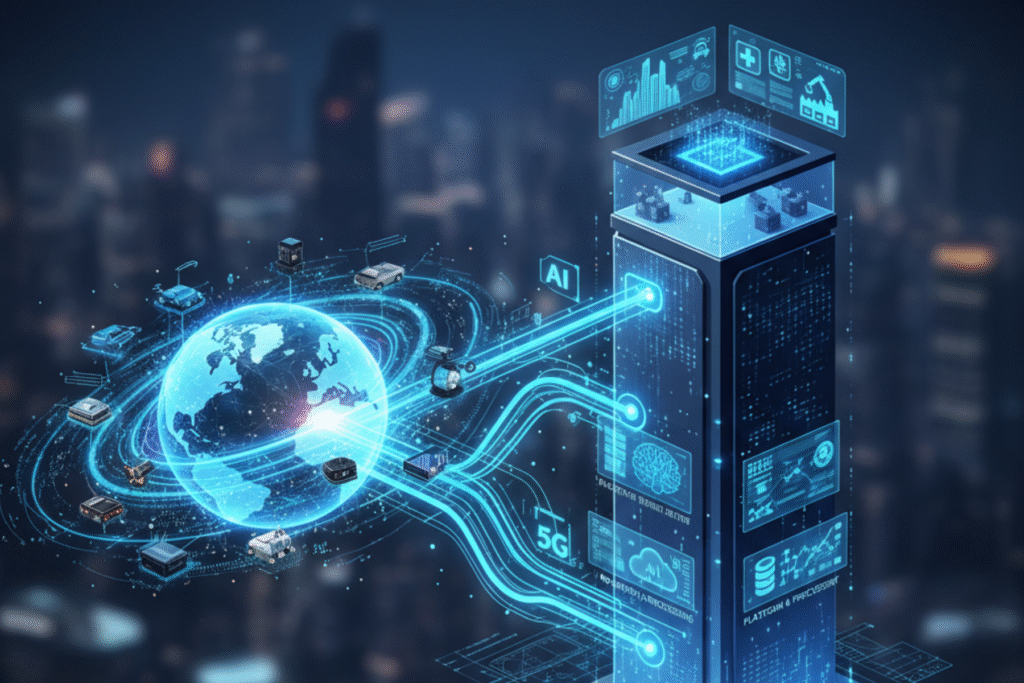
The world is currently witnessing a digital revolution that connects billions of physical objects to the web. However, simply connecting a device to the internet isn’t enough. For a system to be efficient, scalable, and secure, it requires a meticulously designed Internet of Things architecture.
Think of this architecture as the blueprint for a skyscraper. If the foundation is weak, the entire structure eventually collapses under its own weight. For IT professionals and businesses, understanding how data flows from a simple sensor to a complex cloud dashboard is critical.
In this pillar guide, we will explore the nuances of Internet of Things architecture and how it integrates with modern technologies like AI and 5G to transform industries.
What is Internet of Things Architecture?
At its core, Internet of Things architecture is a system of multiple elements: sensors, protocols, actuators, and cloud services. It defines how these components interact to deliver a functional service.
But here is the kicker:
There is no single, universally mandated architecture. Depending on the industry—be it farming or telecommunications—the structure might change. However, most robust systems follow a tiered approach to ensure data integrity.
For a beginner, it might look like a mess of wires and code. But for a professional, it is a sophisticated dance of data acquisition and processing. Consequently, choosing the right framework is the first step toward a successful digital transformation.
The 4-Layer Standard of IoT Systems
To understand the Internet of Things architecture, we must break it down into layers. While some models use three or five, the four-layer model is the industry standard for enterprise solutions.
1. The Perception Layer
This is the physical layer. It consists of the Internet of Things devices that interact with the environment. Whether it is a temperature sensor or a high-definition camera, this layer “sees” the world.
2. The Network Layer
Once the data is collected, it needs to travel. This layer handles the transmission of data from the devices to the processing unit. It relies on technologies like Wi-Fi, 5G, and LoRaWAN.
3. The Processing Layer (Middleware)
This is where the raw data is filtered and pre-processed. You don’t want to send “junk” data to your main servers. This layer ensures only relevant information moves forward.
4. The Application Layer
This is what the end-user sees. It includes dashboards, mobile apps, and control systems. It is the interface where a business owner makes decisions based on real-time data.
[Explore our detailed breakdown of Internet of Things Industrial Applications] https://robologicslab.com/iot-industrial-applications/
The Role of Internet of Things Devices
Every successful IoT ecosystem begins with the hardware. Internet of Things devices act as the nerve endings of the system.
But wait, there’s more.
These devices are no longer just “dumb” sensors. Modern Internet of Things devices possess “Edge Computing” capabilities. This means they can process some data locally before ever sending it to the cloud. This reduces latency and saves massive amounts of bandwidth.
For IT businesses, selecting the right hardware is a balancing act. You must consider power consumption, connectivity range, and durability. In addition, you must ensure that these devices are compatible with your chosen Internet of Things architecture.
Integration: AI and Smart Processing
Static data is boring. The real value of an IoT system comes when you add intelligence. This is where artificial intelligence in internet of things (AIoT) becomes a game-changer.
By integrating AI into the processing layer, the architecture becomes “predictive” rather than just “reactive.” For example, instead of telling you a machine has broken down, an AI-driven architecture tells you it will break down in three days.
Furthermore, AI helps manage the sheer volume of data produced by billions of devices. Consequently, businesses can automate complex tasks without human intervention.
[Learn more about Artificial Intelligence in Internet of Things] https://robologicslab.com/artificial-intelligence-in-internet-of-things/
Industrial Applications and Scaling
In the industrial world, the Internet of Things architecture is often referred to as IIoT (Industrial IoT). Here, the stakes are much higher.
A failure in a smart home’s lightbulb is an inconvenience. A failure in a smart factory’s cooling system is a catastrophe. Therefore, industrial architecture focuses heavily on redundancy and real-time monitoring.
Key benefits for IT businesses include:
- Reduced operational downtime.
- Enhanced supply chain visibility.
- Improved worker safety through wearable sensors.
[External Link Placeholder: Refer to the McKinsey report on the Economic Impact of IoT]
Connectivity: Telecommunications and Energy
The backbone of any Internet of Things architecture is connectivity. This is where internet of things telecommunications plays a vital role. With the advent of 5G, we can now support up to a million devices per square kilometer.
In addition, the internet of things and energy sector is being revolutionized. Smart grids use IoT architecture to balance electricity loads in real-time. This reduces waste and lowers costs for consumers and providers alike.
In addition, many IoT devices are now self-powering, using energy harvesting technologies to run for years without a battery change.
[Discover how the Internet of Things and Energy are creating smart grids] https://robologicslab.com/internet-of-things-and-energy/
[Raad about the evolution of Internet of Things Telecommunications] https://robologicslab.com/internet-of-things-telecommunications/
Security: Protecting the Architecture
As we connect more devices, the “attack surface” for hackers grows. This is why internet of things and cyber security must be baked into the architecture from day one.
You cannot secure a system after it is built. It must be secure by design.
Essential security steps include:
- End-to-end Encryption: Protecting data from the sensor to the cloud.
- Device Authentication: Ensuring only authorized devices can join the network.
- Regular Firmware Updates: Patching vulnerabilities as they arise.
Without these protocols, your Internet of Things architecture is a ticking time bomb. devices are now self-powering, using energy harvesting technologies to run for years without a battery change.
The Future of Precision Farming
Even traditional sectors like agriculture are being transformed. The internet of things farming (Agri-Tech) movement uses sensors to monitor soil moisture, crop health, and cattle location.
By utilizing a specialized Internet of Things architecture, farmers can increase yields while using less water and fertilizer. It is the definition of “doing more with less.”
Think about it:
A farmer in a remote area can now manage thousands of acres from a smartphone. That is the power of a well-implemented IoT framework.
[See the impact of Internet of Things Farming on global food security] https://carijournals.org/journals/IJPID/article/download/2650/3065/7563#:~:text=The%20role%20of%20IoT%20goes,crucial%20for%20a%20sustainable%20future.
Conclusion: Building Your IoT Roadmap
Mastering the Internet of Things architecture is no longer optional for IT professionals. It is a fundamental requirement for the modern digital economy.
From selecting the right Internet of Things devices to securing the network layer, every decision impacts the scalability of your system. Whether you are focusing on industrial efficiency or smart farming, the principles remain the same: connectivity, intelligence, and security.
The future is connected. Are you ready to lead the way?
Frequently Asked Questions (FAQ)
Q: What is the primary focus of Internet of Things architecture?
A: The primary focus is to create a seamless flow of data from physical Internet of Things devices to cloud-based applications, ensuring data is processed efficiently and securely.
Q: How does 5G affect IoT architecture?
A: 5G provides the high bandwidth and low latency necessary for the network layer to handle massive amounts of data in real-time, which is essential for autonomous vehicles and industrial robotics.
Q: Why is security a major challenge in IoT?
A: Because many Internet of Things devices have limited processing power, they often lack built-in security features. This makes the overall internet of things and cyber security strategy vital to protect the network from hackers.
Q: Can I use AI with my existing IoT architecture?
A: Yes. Most modern architectures are designed to be modular. You can integrate artificial intelligence in internet of things by adding AI models to the processing or cloud layers to analyze data patterns.nected. Are you ready to lead the way?