
What is Intralogistics?
Intralogistics refers to the internal management, optimization, and automation of material flows, information, and processes within a single facility—typically a warehouse, distribution center, manufacturing plant, or fulfillment operation. It encompasses the movement of goods from receiving docks through storage, order preparation, internal transport, and outbound staging, all while minimizing waste, errors, and delays.
Unlike broader supply chain logistics (which includes external transport), intralogistics focuses exclusively on internal efficiency — ensuring the right materials arrive at the right place at the right time inside the building. In today’s environment of e-commerce growth, labor shortages, and rising SKU complexity, strong intralogistics is essential for achieving high throughput, low cycle times, and cost-effective operations.
Key processes include:
- Receiving and put-away
- Storage and inventory management
- Internal transport and line feeding
- Order picking and consolidation
- Sorting and outbound preparation
Modern intralogistics increasingly relies on automation technologies like conveyors, AS/RS, and especially Autonomous Mobile Robots (AMRs) to create flexible, responsive internal supply chains.
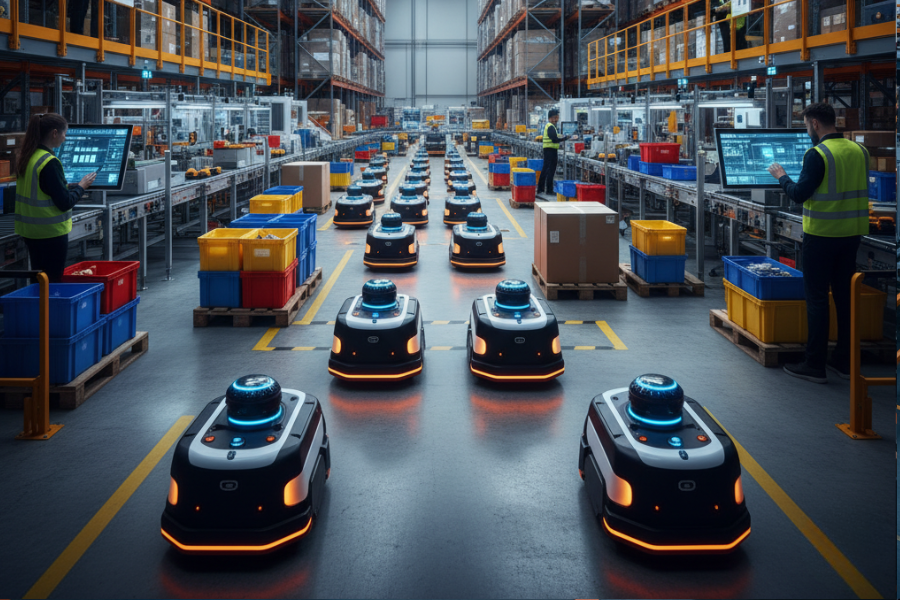
Role of AMRs in Intralogistics
Autonomous Mobile Robots (AMRs) serve as the backbone of advanced intralogistics by providing dynamic, infrastructure-free material transport and coordination within the facility.
AMRs use onboard sensors (LiDAR, 3D cameras, ultrasonic), AI navigation, and SLAM (Simultaneous Localization and Mapping) to move freely without fixed paths, magnets, or tapes — unlike traditional AGVs. This allows them to:
- Transport totes, pallets, carts, or components between zones.
- Deliver just-in-time materials to production lines or picking stations.
- Support hybrid human-robot workflows in shared spaces.
- Adapt instantly to layout changes, obstacles, or priority tasks.
In intralogistics, AMRs bridge silos: they connect receiving with storage, production with assembly, and picking with packing. They enable decentralized decision-making while integrating with central WMS/ERP systems for real-time visibility. As of 2025–2026, AMRs are the fastest-growing segment in intralogistics automation, driven by their flexibility, scalability, and ability to operate in dynamic, mixed environments.
Intralogistics Automation Report
Workflow Optimization with Intralogistics Robots
AMRs transform traditional rigid workflows into adaptive, data-driven processes that eliminate bottlenecks and non-value-added movement.
Typical optimized workflow:
- Task Assignment — WMS or fleet software assigns transport jobs based on real-time demand (e.g., low stock alert at assembly line).
- Dynamic Routing — AMR calculates the shortest, collision-free path using live environmental data and predicts traffic.
- Load Handling — Robot approaches, lifts/engages the load (via forks, rollers, or hooks), and transports it safely.
- Interaction & Delivery — AMR interfaces with fixed equipment (conveyors, wrappers) or human stations, then confirms delivery via API.
- Continuous Optimization — Robot returns to charging or next task; fleet software rebalances loads across the entire AMR population.
This results in:
- Reduced internal transport time by 30–60%
- Just-in-time material supply with minimal buffers
- Seamless scaling during peak periods
- Lower energy use through predictive routing
In manufacturing-linked warehouses, AMRs enable lean principles by delivering parts exactly when needed, cutting WIP inventory and floor space requirements.
AI-Based Fleet Management
AI-powered fleet management is the intelligence layer that turns individual AMRs into a coordinated, high-performance swarm.
Modern systems use AI for:
- Predictive Traffic Management — Anticipate congestion and assign conflict-free paths proactively (e.g., Brightpick Intuition or KINEXON AI Assist).
- Task Prioritization & Assignment — Dynamically allocate jobs based on urgency, robot location, battery status, and workload balance.
- Predictive Maintenance — Analyze sensor data to forecast failures and schedule charging/downtime.
- Real-Time Optimization — Adjust routes in milliseconds based on live events (human movement, blocked aisles).
- Analytics & Simulation — Provide dashboards showing utilization, bottlenecks, and “what-if” scenarios for layout changes.
Case examples include DSV with Locus Robotics (peak scaling via dynamic fleet sizing) and various deployments achieving 50%+ reductions in idle time and traffic delays. AI fleet software ensures maximum robot utilization, often pushing fleet efficiency above 90% in dense operations.
Conclusion
Intralogistics robots, led by Autonomous Mobile Robots (AMRs), are redefining internal warehouse logistics by delivering flexible transport, seamless workflow integration, and intelligent AI-driven fleet coordination. They address core challenges like labor shortages, layout variability, and throughput demands while enabling lean, responsive operations aligned with Industry 4.0 principles.
As intralogistics continues to evolve toward fully connected, predictive systems, AMRs will remain central to achieving operational excellence. Explore the complete ecosystem of mobile robotics in warehouses in our pillar guide: [Internal Link: Mobile Robots for Warehouse Management].
Ready to enhance your internal flows? Contact intralogistics specialists for a site assessment and discover how AMRs can optimize your facility today.
To understand how these systems work together, read our complete guide on mobile robots for warehouse management.