
Introduction
Inventory handling robots are transforming one of the most time-consuming and error-prone aspects of warehouse operations: maintaining accurate, up-to-date stock records. These specialized Autonomous Mobile Robots (AMRs) patrol aisles autonomously, scan shelves, read barcodes or RFID tags, capture images, and update inventory databases in real time—eliminating manual cycle counts and reducing discrepancies that cost warehouses millions annually.
By combining mobility, advanced sensors (LiDAR, cameras, RFID readers), and AI-driven navigation, inventory handling robots provide continuous visibility without disrupting daily picking or put-away activities. This cluster article focuses on their role in achieving near-100% inventory accuracy while complementing other AMR applications. For the broader landscape of mobile robotics in warehouses, see our pillar guide: [Internal Link: Mobile Robots for Warehouse Management].
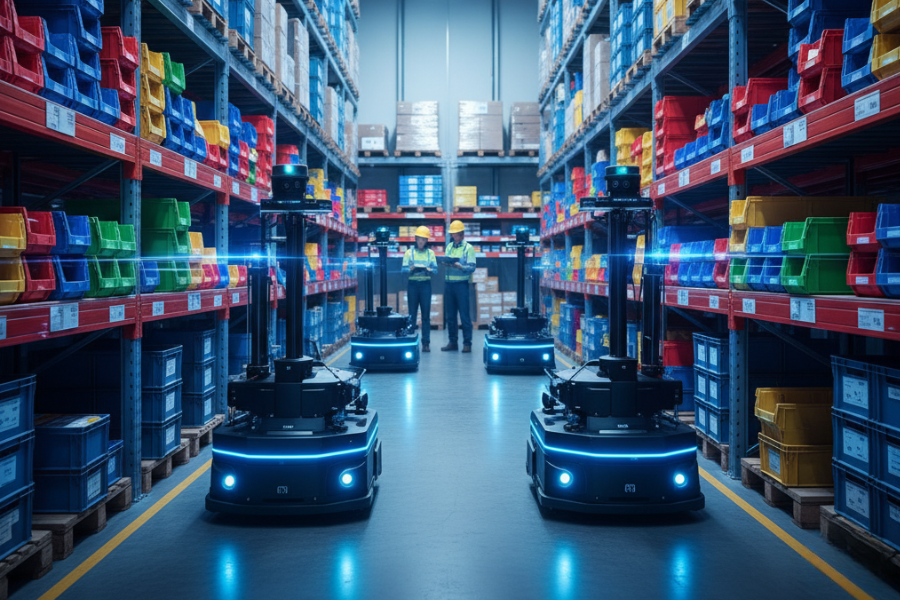
Role of AMRs in Inventory Handling
Inventory handling robots perform three core functions using AMR technology:
- Autonomous Cycle Counting & Auditing — Robots follow optimized routes through the warehouse, scanning every location at scheduled intervals (daily, weekly, or continuously in high-turnover zones).
- Real-Time Location & Status Monitoring — Equipped with RFID, barcode scanners, or vision systems, they detect misplaced items, low stock, or damaged goods and flag issues instantly.
- Data Collection for Analytics — Robots capture shelf images, 3D spatial data, or environmental readings (temperature in cold storage), feeding rich datasets into analytics platforms for predictive restocking and layout optimization.
Unlike static RFID portals or manual handheld scanners, AMRs bring the scanning capability directly to the inventory, covering vast areas efficiently and repeatedly without human fatigue or bias.
Integration with WMS
Seamless integration with Warehouse Management Systems (WMS) is what turns inventory handling robots from mobile scanners into intelligent decision-support tools.
- Bidirectional Communication — Via APIs or middleware, the AMR fleet receives task assignments (e.g., “audit zone A-12”) from the WMS and pushes scan results, location updates, and exceptions back in real time.
- Dynamic Task Orchestration — The WMS can trigger inventory robots during low-activity periods or after large receipts/shipments to verify stock instantly.
- Unified Data Layer — Inventory records stay synchronized across WMS, ERP, and analytics dashboards, enabling automated alerts for discrepancies > threshold (e.g., ±2%).
- Examples of Integration Patterns — Robots often connect through fleet management software (e.g., from MiR, Locus, or Dexory) that acts as a bridge, translating robot telemetry into WMS-understandable events.
This tight coupling ensures inventory data is always current, supporting just-in-time replenishment and preventing stockouts or overstock.
Inventory Automation Using AMRs
Accuracy, Efficiency, and Real-Time Tracking Benefits
Deploying inventory handling robots delivers measurable improvements across key performance indicators:
- Near-Perfect Accuracy — Continuous automated scanning reduces human error; many deployments report inventory accuracy rising from 95–97% (manual) to 99.5–99.9%.
- Efficiency Gains — Robots cover thousands of locations per shift without breaks, freeing staff from tedious counting tasks. Cycle counts that once took days now run incrementally in background.
- Real-Time Tracking & Visibility — Stock levels update instantly upon scan; discrepancies trigger immediate investigations or auto-adjustments, minimizing “ghost inventory.”
- Labor & Cost Reduction — Reduces need for dedicated inventory teams; payback often occurs within 12–24 months through avoided write-offs and optimized purchasing.
- Additional Value — Provides digital twin-like insights (shelf fullness, product condition) for better slotting decisions and demand forecasting.
These benefits compound in high-SKU environments where manual tracking becomes impractical.
Use Cases in Large Warehouses
Inventory handling robots shine in large-scale, complex facilities:
- E-commerce Fulfillment Centers — High SKU velocity and frequent layout changes demand constant verification. Robots perform nightly audits across millions of locations (similar to Dexory-style solutions).
- Third-Party Logistics (3PL) Providers — Multi-client warehouses benefit from client-specific accuracy reporting; AMRs scan and attribute stock by owner in real time.
- Retail Distribution Centers — Large footprints with seasonal peaks use robots for proactive low-stock detection, ensuring shelves are replenished before demand spikes.
- Manufacturing & Spare Parts Warehouses — Critical components require 100% traceability; robots log exact locations and quantities, supporting lean/just-in-time production.
- Cold-Chain & Pharma Warehouses — Temperature-controlled units equipped with sensors monitor conditions while scanning, ensuring compliance and product integrity.
Companies like DHL, Walmart, and specialized providers have deployed such systems to maintain tight control over massive inventories.
FAQs
What are inventory handling robots?
Inventory handling robots are Autonomous Mobile Robots (AMRs) equipped with scanners, cameras, and AI navigation that autonomously patrol warehouses to count stock, verify locations, and update inventory records in real time.
How accurate are AMR-based inventory systems?
Deployments frequently achieve 99.5–99.9% accuracy by eliminating human counting errors and providing continuous verification—far surpassing traditional manual methods.
Do inventory robots replace cycle counting teams?
They significantly reduce (often by 70–90%) the need for manual cycle counts by performing automated, incremental audits, allowing staff to focus on higher-value tasks.
Can inventory handling AMRs integrate with existing WMS?
Yes—most modern solutions connect via APIs or middleware, enabling real-time bidirectional data flow for task assignment and instant inventory updates.
What is the typical ROI timeframe for inventory robots?
Payback periods range from 12–24 months, driven by reduced labor, fewer stock discrepancies, lower write-offs, and improved order fulfillment rates.
Conclusion
Inventory handling robots powered by Autonomous Mobile Robots (AMRs) represent a quiet revolution in warehouse accuracy and visibility. By automating tedious counting tasks, integrating tightly with WMS platforms, and delivering real-time data, they help large operations maintain near-perfect stock records while freeing human workers for strategic work.
As supply chains grow more complex, these robots become essential infrastructure for resilient, data-driven warehouses. Dive deeper into the full spectrum of mobile robot applications in our pillar guide: [Internal Link: Mobile Robots for Warehouse Management].
Ready to explore inventory automation? Reach out to AMR providers for a site assessment and discover how continuous tracking can transform your operations.
To understand how these systems work together, read our complete guide on mobile robots for warehouse management.