
Introduction
The IoT product lifecycle encompasses the end-to-end journey of an Internet of Things device or system, from initial conception through design, development, production, deployment, and ongoing operations until retirement. This structured process ensures that IoT products not only meet initial requirements but also adapt to evolving needs, maintain security, and deliver long-term value. Understanding the IoT product lifecycle is crucial for managing the intricate interplay of hardware, firmware, software, and cloud components that define connected systems.
What sets the IoT lifecycle management apart from traditional electronics or software products is its inherent complexity. Traditional electronics might focus on one-time manufacturing with limited post-sale support, while software can be updated digitally without physical constraints. IoT, however, combines both worlds: devices must endure physical environments like extreme temperatures or vibrations, while requiring seamless over-the-air (OTA) updates, continuous data monitoring, and robust cybersecurity across distributed networks. Failures in any phase can lead to costly recalls, security breaches, or operational downtime.
This article builds on the broader framework outlined in our pillar guide, [Internal Link: The Complete IoT Product Development Roadmap: From Idea to Scalable Deployment], by providing an in-depth exploration of the IoT product lifecycle stages. Here, we’ll dissect each phase with practical engineering insights, helping you navigate the IoT development lifecycle to build reliable, scalable systems. Whether you’re an embedded engineer, IoT developer, startup founder, or product manager, this guide equips you with the knowledge to optimize your IoT system lifecycle for efficiency and longevity.
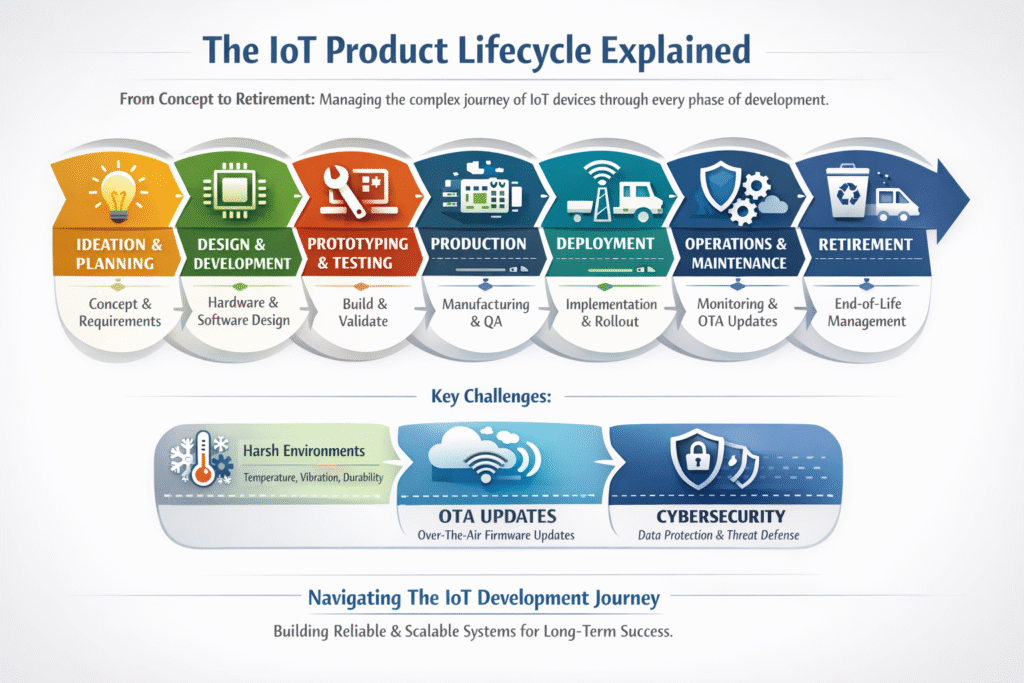
What Makes IoT Product Lifecycle Different?
The IoT product lifecycle stands out due to its multifaceted nature, integrating hardware, firmware, cloud infrastructure, and user applications into a cohesive ecosystem. Unlike standalone electronics, where the lifecycle might end at manufacturing, or pure software, where updates are straightforward, IoT demands ongoing management across all layers.
Physical device constraints play a pivotal role. IoT devices often operate in harsh conditions—think industrial sensors in factories or wearables in varying climates—requiring designs that prioritize durability, power efficiency, and modularity. This adds layers of complexity to the IoT device lifecycle, as hardware revisions can’t be as agile as software patches.
Security and long-term maintenance pose unique challenges. With devices connected to networks, vulnerabilities can emerge post-deployment, necessitating continuous threat monitoring and patches. OTA firmware updates become essential, allowing remote fixes without physical access, but they require careful planning to avoid disrupting operations.
Continuous updates extend beyond firmware to cloud services and applications. Changes in backend APIs or data models can ripple through the system, demanding version compatibility across the IoT system lifecycle.
Finally, operational monitoring after deployment is non-negotiable. IoT products generate vast data streams, enabling predictive maintenance but also requiring robust analytics platforms. This shifts the lifecycle from a linear process to a cyclical one, where feedback loops inform iterations and extend product life.
These differences underscore why IoT product lifecycle management (PLM) requires a holistic, system-level approach, far beyond traditional product development.
Stage 1: Idea Validation and Feasibility Analysis
The IoT product lifecycle begins with rigorous idea validation and feasibility analysis, setting the foundation for all subsequent stages. This phase ensures the concept aligns with market needs and technical realities, preventing wasted resources later.
Start with problem definition and use-case clarity. Articulate the core issue your IoT product addresses—for example, optimizing energy consumption in smart buildings. Develop detailed user stories and scenarios to map how the device interacts with users and environments.
Market validation involves customer interviews, surveys, and competitor analysis. Tools like Google Trends or industry reports can gauge demand. For instance, in healthcare IoT, validate if remote patient monitoring reduces hospital readmissions.
Technical feasibility assessment evaluates hardware, software, and connectivity options. Assess if low-power MCUs like ESP32 can handle required computations while meeting battery life goals. Consider connectivity protocols (e.g., MQTT vs. CoAP) for data efficiency.
Risk analysis identifies potential pitfalls, such as supply chain disruptions for components or regulatory hurdles in data privacy (GDPR compliance). Use FMEA (Failure Mode and Effects Analysis) to prioritize risks.
Early cost estimation creates a rough BOM (Bill of Materials) and projects development timelines. Factor in prototyping costs ($10,000–50,000) versus scaling.
This stage integrates seamlessly into the broader IoT product development roadmap by confirming viability before committing to design. Skipping it often leads to pivots mid-lifecycle, inflating costs. [The Complete IoT Product Development Roadmap: From Idea to Scalable Deployment]
Stage 2: System Architecture and Design
In the IoT development lifecycle, system architecture and design translate validated ideas into blueprints. This stage defines the product’s structure, influencing scalability, security, and maintainability.
Begin with system block diagram creation, visualizing components like sensors, processors, and interfaces. Use tools like Draw.io for hierarchical diagrams showing data paths from edge to cloud.
Hardware architecture planning selects components: MCUs (STM32 for industrial robustness), sensors (e.g., IMU for motion detection), and power systems. Balance cost, performance, and power—opt for Li-Po batteries in wearables for longevity.
Firmware architecture planning structures code modules for modularity. Implement RTOS (FreeRTOS) for multitasking, ensuring efficient sensor polling and error handling.
Cloud/backend architecture design chooses platforms like AWS IoT or Azure IoT Hub for device management and analytics. Design scalable databases (e.g., InfluxDB for time-series data) and APIs for secure interactions.
Data flow mapping outlines transmission: from device via BLE to gateway, then to cloud over HTTPS. Incorporate edge computing for low-latency decisions, reducing cloud dependency.
Embed security-by-design principles: Use TLS encryption, secure boot, and role-based access. These decisions ripple forward—poor architecture complicates certification or scaling, potentially requiring redesigns in later IoT product lifecycle stages.
[Internal Link: Turning an Idea into an IoT System Architecture]
Stage 3: Hardware and Firmware Development
This hands-on phase of the IoT device lifecycle focuses on building and iterating physical and embedded elements.
PCB design and prototyping start with schematic capture in tools like KiCad or Altium. Layout traces for signal integrity, incorporating RF considerations for wireless modules. Prototype with 3D-printed enclosures to test fit and thermal performance.
Component selection prioritizes reliability: Choose automotive-grade parts for vibration resistance in vehicle IoT. Balance BOM costs—e.g., $5 MCUs versus $20 for advanced features.
Embedded firmware development uses C/C++ for low-level control. Implement drivers for peripherals, power management states, and fault tolerance. Use version control (Git) for branching features.
Communication protocol implementation ensures seamless connectivity: Integrate MQTT clients for pub/sub messaging, handling reconnections and QoS levels.
Early integration testing verifies hardware-firmware synergy, using oscilloscopes for signal analysis and debuggers (JTAG) for code stepping.
Iteration cycles are key—expect 3-5 revisions based on testing feedback. Document changes meticulously to avoid regressions. This stage’s outputs feed into integration, where flaws in development amplify costs if undetected.
Stage 4: Integration and System Validation
Integration and validation unify components in the IoT product engineering process, ensuring the system functions as a whole.
Hardware-firmware integration assembles prototypes, flashing firmware and verifying sensor accuracy. Use automated scripts for repeatability.
Cloud connectivity testing simulates real-world networks: Test failover in spotty Wi-Fi, measuring latency with tools like Wireshark.
Mobile/web application integration links devices to user interfaces. Develop apps in React Native, ensuring API compatibility for data visualization.
Functional testing covers use cases: End-to-end scenarios like alert triggering on threshold breaches.
Stress testing and reliability testing expose limits: Thermal cycling, drop tests, and accelerated aging to predict MTBF (Mean Time Between Failures).
Security validation includes penetration testing for vulnerabilities like buffer overflows or weak encryption.
Documentation and version control are vital—maintain wikis for APIs and Git repos for code. This phase catches 70-80% of issues, preventing field failures.
Stage 5: Certification and Pre-Production Preparation
As the IoT system lifecycle advances to pre-production, certification ensures compliance and manufacturability.
Regulatory compliance planning targets standards: FCC for RF emissions in the US, CE for EU safety. Prepare documentation early, like schematics for audits.
EMI/EMC testing considerations involve anechoic chambers to measure interference. Design shielded enclosures to pass.
Production firmware stabilization locks features, optimizing for size and security. Implement rollback mechanisms.
DFM refines designs: Standardize footprints, reduce layer counts in PCBs for cost.
Pilot production runs (100-500 units) validate assembly lines, identifying jigs needed for efficiency.
Mistakes in earlier stages—like non-compliant components—can double certification costs ($20,000–100,000). Plan iteratively to mitigate.
[Internal Link: IoT Product Certification and Compliance Overview]
Stage 6: Manufacturing and Deployment
Manufacturing scales the IoT product lifecycle to volume production, followed by deployment.
Mass production planning selects CMs (Contract Manufacturers) with IoT expertise. Implement ERP for tracking.
Supply chain coordination secures components, using alternatives to avoid shortages (e.g., dual-sourcing MCUs).
Quality control processes include AOI (Automated Optical Inspection) and functional testing jigs, targeting 99% yield.
Device provisioning and identity management assigns unique keys via secure servers, enabling authentication.
Field deployment strategy rolls out in phases: Beta sites first, then full launch with logistics planning.
This stage demands precision—poor execution leads to recalls, eroding trust.
[Internal Link: Scaling from Prototype to Production]
Stage 7: Post-Deployment Operations and Maintenance
Post-deployment shifts the IoT development stages to operations, where products live in the real world.
OTA firmware updates deliver patches securely: Use differential updates to minimize bandwidth, via platforms like Particle.io.
Remote monitoring and diagnostics employ dashboards (Grafana) for metrics like battery health, alerting on anomalies.
Data analytics and performance optimization leverage ML for insights, e.g., predicting failures from vibration data.
Cybersecurity updates manage vulnerabilities: Regular scans and zero-trust models protect fleets.
Product lifecycle extension strategies include modular upgrades or software enhancements to prolong usability.
IoT requires thiIoT Product Lifecycle Management (PLM) Strategy
Effective PLM unifies the IoT product lifecycle with tools and practices.
Documentation standards use Markdown wikis for specs, ensuring team alignment.
Version control practices track hardware (e.g., Eagle files in Git) and software changes.
Hardware revision tracking labels boards (Rev A, B) with changelogs.
Cloud change management deploys updates via CI/CD pipelines, testing compatibility.
End-of-life planning includes secure decommissioning and recycling, complying with e-waste laws.
A strong PLM reduces downtime and extends ROI.
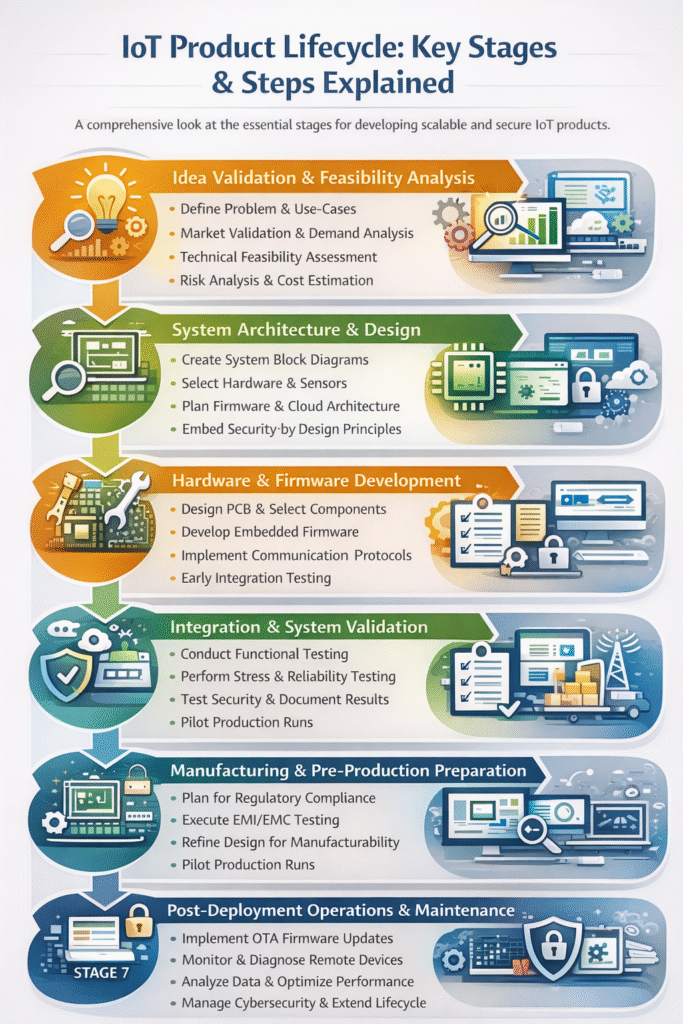
Common Lifecycle Mistakes in IoT Projects
Skipping proper validation leads to misaligned products, wasting 30-50% of budgets.
Ignoring scalability results in cloud bottlenecks as devices grow.
Underestimating post-deployment costs overlooks monitoring expenses, which can exceed development.
No OTA update architecture leaves devices vulnerable without remote fixes.
Weak documentation hampers troubleshooting, prolonging issues.
Avoid these by adopting iterative, documented approaches.
Lifecycle Skill Mapping
Mapping skills to IoT product lifecycle stages ensures capable teams:
- Idea Validation: Product management for market analysis.
- Architecture: Cloud architecture for backend design; embedded systems engineering for hardware.
- Development: PCB design (Altium); firmware engineering (C++).
- Integration: DevOps for CI/CD; cybersecurity for validation.
- Certification: Regulatory experts.
- Manufacturing: Supply chain specialists.
- Maintenance: Data analysts for optimization.
Cross-training fosters collaboration.
FAQ
What is the IoT product lifecycle?
The IoT product lifecycle covers stages from idea validation to post-deployment maintenance, managing hardware, firmware, and cloud integration.
Why is IoT device lifecycle management complex?
It involves physical constraints, continuous updates, security needs, and operational monitoring across distributed systems.
What are key IoT development stages?
Stages include validation, architecture, development, integration, certification, manufacturing, and maintenance.
How does OTA impact IoT system lifecycle?
OTA enables remote firmware updates, extending product life and addressing vulnerabilities without recalls.
What skills are needed for IoT product lifecycle?
Skills range from embedded engineering and PCB design to cloud architecture, cybersecurity, and product management.
How to avoid common IoT lifecycle mistakes?
Prioritize validation, scalability, OTA planning, and strong documentation from the start.
What is IoT product lifecycle management (PLM)?
PLM involves strategies for documentation, version control, and end-of-life planning to optimize the entire lifecycle.
Conclusion
The IoT product lifecycle—from idea validation through architecture, development, integration, certification, manufacturing, deployment, and maintenance—forms a comprehensive framework for building enduring connected systems. Each stage builds on the last, emphasizing iteration, security, and scalability to navigate IoT’s unique challenges.
Lifecycle thinking is essential for successful IoT product development, as it anticipates long-term needs and minimizes risks. By mastering these stages, you can create products that not only launch effectively but thrive in operation.
For a holistic view, explore our pillar article: [Internal Link: The Complete IoT Product Development Roadmap: From Idea to Scalable Deployment]. As your practical authority in IoT system and product development, we provide engineering-focused guides to empower your projects.s long-term management because devices operate indefinitely, generating value through data—unlike disposables.