
Definition and Importance of Last-Mile Automation
Last-mile warehouse automation refers to the technologies and processes that optimize the final stages of order fulfillment inside the warehouse — from order consolidation and sorting to staging, packing, and loading for outbound dispatch. While “last-mile” traditionally describes delivery from warehouse to customer door, in warehouse contexts it focuses on the critical “last yard” or pre-dispatch phase that directly impacts delivery speed, cost, and reliability.
This phase is vital because it bridges internal operations with external logistics: delays here cascade into missed cut-off times, higher expedited shipping costs, and dissatisfied customers. In e-commerce, where same-day/next-day delivery expectations dominate, last-mile warehouse automation enables faster processing, higher throughput during peaks, and greater accuracy to minimize returns and rework.
Autonomous Mobile Robots (AMRs) play a central role by automating repetitive transport, sorting, and staging tasks, reducing human touchpoints and enabling warehouses to meet rising volume demands without proportional labor increases. For broader insights into mobile robotics, see our pillar guide: [Internal Link: Mobile Robots for Warehouse Management].
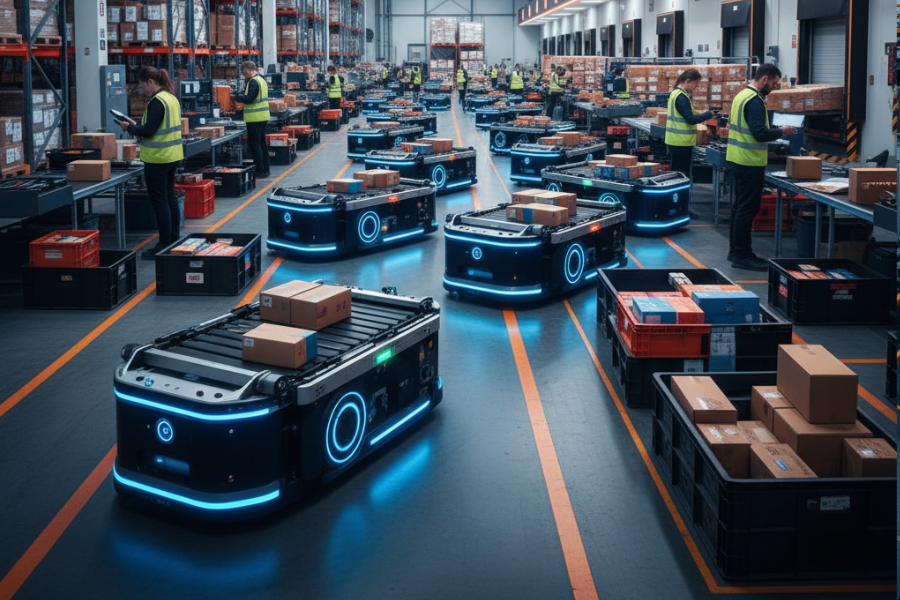
AMR Role in Sorting and Staging
AMRs enhance last-mile warehouse automation through intelligent, flexible movement and coordination:
- Automated Sorting — AMRs equipped with conveyor tops, tilt trays, or vision-guided systems transport individual parcels or totes to correct chutes, lanes, or zones based on destination, carrier, or priority. They integrate with sortation software for dynamic routing.
- Order Consolidation & Staging — After picking, AMRs collect completed orders from multiple zones, consolidate them into totes or carts, and deliver to packing stations or staging areas. This eliminates manual cart pushing and reduces staging congestion.
- Buffering & Sequencing — In high-volume setups, AMRs buffer items temporarily or sequence them for packing/shipping in optimal order (e.g., heaviest first), improving load stability and dispatch efficiency.
- Seamless Dispatch Prep — Robots move staged orders to outbound docks, feed automated loaders, or prepare for carrier handoff, often 24/7 with real-time WMS updates.
Powered by LiDAR, SLAM, AI path optimization, and fleet management software, AMRs adapt to layout changes, avoid obstacles, and prioritize urgent orders — accelerating the entire pre-dispatch flow.
E-commerce Warehouse Use Cases
E-commerce fulfillment centers rely heavily on last-mile warehouse automation to handle high SKU variety, small orders, and tight SLAs:
- High-Volume Fulfillment Centers — Operators like Amazon and Alibaba use AMR fleets for parcel sorting and staging, processing thousands of orders per hour during peaks. AMRs route packages to carrier-specific lanes, enabling faster truck loading.
- Urban Micro-Fulfillment & Dark Stores — Companies deploy compact AMRs to sort and stage groceries or quick-commerce items for same-hour delivery, reducing processing time from hours to minutes.
- 3PL & Multi-Client Warehouses — Providers sort and stage client-specific orders with AMRs, ensuring accurate carrier handoffs and compliance with varied SLAs.
- Peak-Season Scaling — During holidays, e-commerce warehouses add AMRs modularly to handle 50%+ volume spikes without hiring surges, maintaining dispatch accuracy.
Real-world examples show 25-30% faster order processing and 200-300% productivity lifts in upstream tasks that feed last-mile prep.
Benefits and Challenges
Key Benefits:
- Speed — AMRs cut transport and staging time by 30-60%, extending carrier cut-off windows and enabling same-day/next-day fulfillment.
- Accuracy — Reduced manual handling drops errors to <0.1%, minimizing misrouted packages and returns.
- Labor Efficiency — Automates repetitive moves, allowing staff to focus on value-added packing/quality checks; reduces dependency during shortages.
- Scalability & Flexibility — Easy to add robots for peaks; no fixed infrastructure needed.
- Cost Savings — Lower labor/overtime, fewer expedites, and optimized dock utilization yield strong ROI (often 12-24 months).
Challenges:
- Upfront Investment — Fleet, software, and integration costs can be significant, though RaaS models ease entry.
- Integration Complexity — Requires tight WMS/ERP connectivity; legacy systems may need upgrades.
- Space & Layout Constraints — Dense urban facilities limit robot paths; floor conditions affect performance.
- Maintenance & Downtime — Battery charging and software updates demand planning to avoid bottlenecks.
- Change Management — Staff training and workflow shifts needed for smooth adoption.
Despite challenges, AMRs deliver measurable gains in speed, accuracy, and resilience for last-mile warehouse operations.
Conclusion
Last-mile warehouse automation, powered by Autonomous Mobile Robots (AMRs), transforms the critical pre-dispatch phase by accelerating sorting, staging, and loading while boosting accuracy and throughput. In e-commerce-driven environments, these systems enable faster, more reliable fulfillment that meets customer expectations for speed and precision.
As demand for rapid delivery grows, AMRs provide the flexible, scalable solution warehouses need to stay competitive. Dive deeper into mobile robot applications in our pillar guide: [Internal Link: Mobile Robots for Warehouse Management].
Ready to optimize your last-mile operations? Evaluate AMR solutions for your facility and unlock faster, more accurate dispatch today.
To understand how these systems work together, read our complete guide on mobile robots for warehouse management.