
What is Material Handling Automation?
Material handling automation refers to the use of technology to move, store, protect, and control materials and products throughout manufacturing, warehousing, distribution, and disposal processes. It encompasses systems that automate the flow of goods from receiving to shipping, minimizing manual intervention to improve speed, accuracy, and consistency.
Key components include conveyors, automated guided vehicles (AGVs), autonomous mobile robots (AMRs), automated storage and retrieval systems (AS/RS), robotic arms, sortation equipment, and integrated software. The goal is to reduce labor dependency, cut operational costs, enhance safety, and boost throughput in high-volume environments like e-commerce fulfillment centers, manufacturing plants, and 3PL operations.
In 2025–2026, material handling automation is shifting toward flexible, intelligent solutions driven by labor shortages, e-commerce growth, and the need for agile operations. AMRs lead this evolution by offering dynamic navigation and easy scalability without fixed infrastructure.
For the complete picture of mobile robotics in warehouses, see our pillar guide: [Internal Link: Mobile Robots for Warehouse Management].
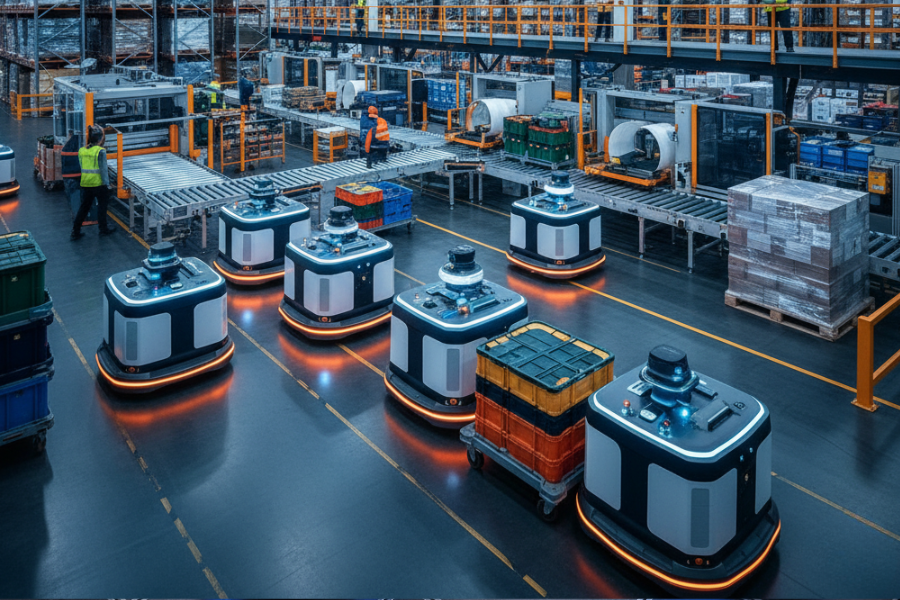
Role of AMRs in Material Handling Automation
Autonomous Mobile Robots (AMRs) are self-navigating vehicles that use onboard sensors (LiDAR, cameras, ultrasonic), AI, and SLAM (Simultaneous Localization and Mapping) to move materials autonomously in dynamic environments. Unlike rigid systems, AMRs adapt paths in real-time, avoid obstacles, and collaborate safely with humans.
In material handling, AMRs perform:
- Horizontal transport of totes, carts, pallets, or components between zones.
- Just-in-time delivery to production lines or picking stations.
- Integration with conveyors, wrappers, or robotic cells for seamless workflows.
- Heavy-load movement (up to 2,500+ kg in some models) with attachments like forks, rollers, or lifts.
AMRs replace repetitive forklift trips and conveyor bottlenecks, enabling 24/7 operation, predictive routing via fleet software, and quick redeployment during layout changes or seasonal peaks. They bridge inbound receiving, storage, production supply, and outbound shipping for end-to-end automation.
[External Link: Material Handling Automation Study]
Comparison with Conveyors and Forklifts
Traditional material handling relies heavily on conveyors and manual/automated forklifts. Here’s how AMRs compare:
| Aspect | Conveyors | Forklifts (Manual/Automated) | Autonomous Mobile Robots (AMRs) |
|---|---|---|---|
| Flexibility | Low – fixed paths, major redesign for changes | Medium – operator-dependent; AGVs need guides | High – dynamic navigation, easy reconfiguration |
| Scalability | Limited – infrastructure-heavy expansions | Good – add units/drivers, but labor-bound | Excellent – add robots modularly, no downtime |
| Speed/Throughput | Very high in steady flows | Variable, depends on operator/traffic | Consistent, 24/7, optimized routing |
| Initial Cost | High (installation, structural changes) | Medium (vehicles + infrastructure for AGVs) | Moderate (per unit ~$20k–$100k+) |
| Maintenance | High (mechanical parts, belts, motors) | High (batteries, tires, hydraulics) | Lower – fewer moving parts, software-focused |
| Safety | Good in segregated zones | High risk of collisions/injuries | Excellent – 360° sensors, collision avoidance |
| Best For | High-volume, fixed routes | Variable, vertical handling | Dynamic, mixed human-robot environments |
AMRs excel in flexible, changing warehouses where conveyors are too rigid and forklifts too labor-intensive or hazardous. They often complement fixed systems (e.g., AMRs feeding conveyors) rather than fully replacing them in every scenario.
Cost and Efficiency Analysis
Upfront Costs — A single AMR unit typically ranges from $20,000–$100,000+ depending on payload, attachments, and features. Fleet deployments (5–50+ units) require additional investment in software, charging infrastructure, and integration.
Efficiency Gains — AMRs reduce material handling time by 30–60%, increase throughput (e.g., 6× in some case studies), and enable continuous operation. They cut labor needs by automating repetitive transport, often lowering cost per move significantly.
ROI Timeline — Most deployments achieve payback in 12–36 months through:
- Labor savings (30–64% reduction reported in forklift-replacement cases)
- Reduced errors/damage
- Lower energy/maintenance vs. traditional equipment
- Scalability without proportional cost increases
Long-term benefits include space optimization (tighter aisles possible), better inventory flow, and resilience to labor shortages. In high-turnover e-commerce or manufacturing settings, AMRs frequently deliver the fastest ROI among automation options.
Safety Considerations
Safety is a top driver for adopting AMRs in material handling:
- Collision Avoidance — 360° LiDAR, 3D cameras, and AI detect humans, obstacles, and loads; robots slow/stop in shared spaces.
- Human-Robot Collaboration — Safe speeds in pedestrian zones, emergency stops, and audible/visual alerts minimize risks.
- Reduced Manual Handling — AMRs eliminate heavy lifting and forklift-related accidents (a leading cause of warehouse injuries).
- Compliance & Standards — Modern AMRs meet ISO 3691-4 and ANSI/ITSDF B56.5 safety requirements.
- Real-World Impact — Deployments often report 50–70%+ drops in material-handling incidents, lowering insurance premiums and downtime.
Compared to forklifts (high injury risk from tipping/collisions) or conveyors (pinch points), AMRs provide superior safety in mixed environments.
Conclusion
Material handling automation is evolving rapidly, with Autonomous Mobile Robots (AMRs) emerging as the most adaptable and future-proof solution for replacing or augmenting traditional conveyors and forklifts. By delivering flexibility, scalability, strong ROI, and enhanced safety, AMRs enable warehouses to meet modern demands for speed, resilience, and cost control.
As e-commerce, labor challenges, and Industry 4.0 pressures intensify, AMRs are no longer optional — they’re essential for competitive material flow. Dive deeper into mobile robot strategies in our pillar guide: [Internal Link: Mobile Robots for Warehouse Management].
Ready to modernize your material handling? Consult AMR specialists for a workflow evaluation and start building a more efficient, safer operation today.
To understand how these systems work together, read our complete guide on mobile robots for warehouse management.