
Introduction to Pallet Transport Robots
Pallet transport robots are specialized Autonomous Mobile Robots (AMRs) engineered to move heavy palletized loads autonomously across warehouse floors, production facilities, and distribution centers. These robots eliminate manual forklift operations for repetitive horizontal transport, handling payloads from 1,000 kg up to 2,500 kg or more depending on the model.
Unlike traditional forklifts or fixed conveyor systems, pallet transport robots navigate dynamically using advanced sensors and AI, adapting to changing layouts, avoiding obstacles, and working safely alongside humans. This makes them ideal for modern warehouses facing labor shortages, safety concerns, and the need for scalable material handling.
As part of the broader shift toward flexible automation, pallet transport robots optimize intralogistics by streamlining flows from receiving docks to storage, production lines, or shipping zones. For a full overview of mobile robotics in warehouses, refer to our pillar guide: [Internal Link: Mobile Robots for Warehouse Management].
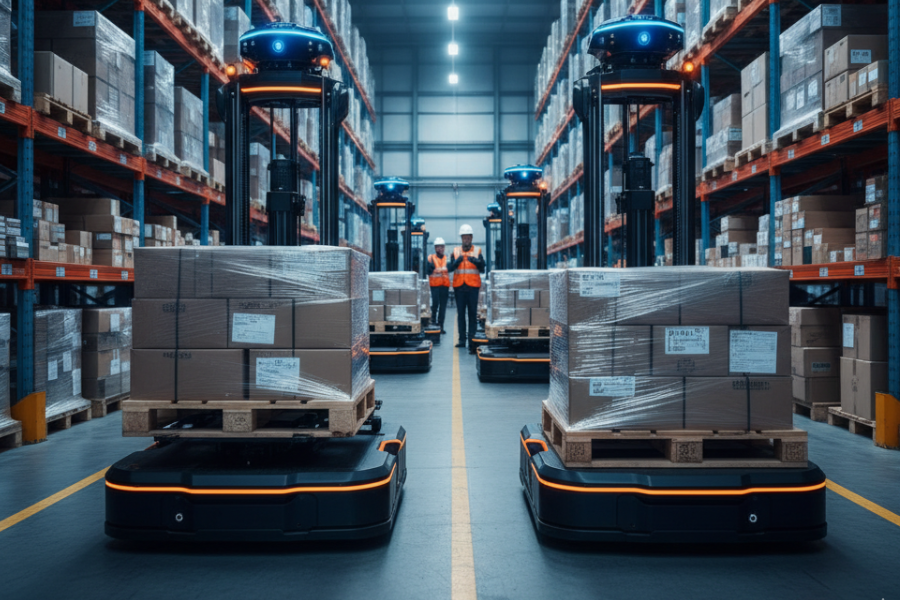
How Pallet Transport Robots Work with AMRs
Pallet transport robots integrate seamlessly with AMR technology to handle pallets efficiently:
- Load Acquisition: The robot approaches the pallet (often positioned on a docking stand, conveyor, or floor), then uses an integrated lifting mechanism, forks, or conveyor top to pick it up securely.
- Navigation and Path Planning: Onboard software generates optimal routes in real-time, rerouting instantly if obstacles appear.
- Transport: The AMR moves the pallet smoothly to the destination while maintaining stability for heavy loads.
- Delivery: It lowers or transfers the pallet to a fixed station, conveyor, or another robot for further processing.
- Return/Next Task: The robot proceeds to the next assignment, often coordinated via centralized fleet management software.
This process supports 24/7 operations with minimal human intervention, significantly reducing cycle times compared to manual methods.
Types of Pallet Transport Robots
Pallet transport AMRs come in several configurations tailored to different warehouse needs:
- Pallet Jack / Low-Lift AMRs: These drive under pallets or use forks to lift from ground level. Ideal for horizontal transport on flat floors; nimble and cost-effective for standard Euro or GMA pallets (payload ~1,000–1,500 kg).
- Pallet Lifter / High-Lift AMRs: Equipped with scissor lifts or telescopic forks to handle transfer to/from elevated platforms or low-level racking (up to 1–2 meters). Useful for interfacing with conveyors or automated storage systems.
- Conveyor-Top AMRs: Feature a powered roller or chain conveyor on top for seamless load transfer to/from fixed conveyors without lifting. Best for high-throughput lines where pallets move continuously.
- Autonomous Forklift-Style AMRs: Advanced models mimic traditional forklifts with full forks and higher lift heights (some up to 8+ meters), combining transport with vertical handling in hybrid setups.
Popular examples include heavy-duty models from manufacturers like Seegrid, OTTO Motors, Jungheinrich, and MiR, which offer payloads up to 2,500 kg and robust designs for industrial environments.
Commercial Pallet Transport AMR
Safety and Navigation Technologies
Safety is critical when handling heavy pallets in shared spaces. Pallet transport robots incorporate multiple layers of protection:
- Navigation Technologies:
- SLAM (Simultaneous Localization and Mapping): Builds and updates digital maps in real-time for precise positioning without fixed infrastructure.
- LiDAR: Primary sensor for 360° scanning, creating accurate 2D/3D environmental models and enabling dynamic obstacle avoidance.
- 3D Cameras and Vision Systems: Detect overhanging obstacles, people, or irregular loads; provide depth perception for safe pallet engagement.
- Safety Features:
- Multi-zone collision avoidance with emergency stops.
- 360° protective fields that slow or halt the robot near humans or hazards.
- Redundant sensors (e.g., ultrasonic for low-level detection) and AI-driven predictive behavior.
- Compliance with ISO 3691-4 standards for industrial trucks.
These technologies allow safe operation in mixed human-robot environments, reducing accidents by minimizing forklift-related risks.
Heavy-Load Warehouse Applications
Pallet transport robots excel in scenarios involving heavy, repetitive movements:
- Inbound Receiving to Storage: Move pallets from docks to racking or bulk storage zones.
- Production Line Supply: Deliver raw materials or components just-in-time to assembly stations.
- End-of-Line to Shipping: Transport finished pallets from palletizers to wrappers, staging areas, or outbound docks.
- Cross-Docking: Facilitate fast transfer in high-volume distribution centers.
- Cold Storage or Manufacturing: Operate reliably in harsh conditions where manual handling is challenging.
Real-world deployments in e-commerce, manufacturing, and 3PL operations show these robots handling thousands of pallet moves daily, improving flow and reducing bottlenecks.
ROI and Scalability Benefits
Investing in pallet transport robots delivers strong returns through operational gains:
- Cost Savings: Reduce labor dependency (often 30–60% in transport tasks), overtime, and damage claims. Typical payback periods range from 12–36 months, with some case studies reporting 18-month ROI via productivity boosts of 30–50%.
- Productivity Gains: Increase throughput by automating long-haul moves; fleets scale throughput without proportional staff increases.
- Scalability: Start with a few units and expand modularly during peaks (e.g., seasonal e-commerce surges) without infrastructure changes.
- Flexibility: Easily reconfigure for layout shifts or new workflows via software updates—no rewiring or magnets needed.
- Safety ROI: Fewer incidents lower insurance and downtime costs.
Overall, these robots provide a future-proof solution for warehouses seeking agile, cost-effective heavy-load automation.
Conclusion
Pallet transport robots, driven by Autonomous Mobile Robots (AMRs), are transforming heavy material handling by offering safe, flexible, and efficient pallet movement without fixed infrastructure. From advanced navigation with LiDAR and SLAM to high-payload capabilities and rapid scalability, they address key warehouse challenges like labor shortages and throughput demands.
As supply chains evolve, integrating pallet transport robots enhances competitiveness and prepares facilities for higher automation levels. Explore how they fit your operations — dive deeper into mobile robotics strategies in our pillar guide: [Internal Link: Mobile Robots for Warehouse Management].
Ready to automate your pallet flows? Contact leading providers for demos and assessments to unlock efficiency gains today.
To understand how these systems work together, read our complete guide on mobile robots for warehouse management.