
Picking vs Sorting: Key Differences in Warehouse Operations
While often mentioned together, picking and sorting are distinct but complementary processes in warehouse fulfillment.
- Order Picking
Selecting individual items (or groups of items) from storage locations to fulfill specific customer orders.
Primary goal: accuracy + speed per order
Common challenges: high SKU variety, small order sizes, walking/travel time, human error - Sorting
Organizing already-picked items into destination-specific groups — by carrier, ZIP code, customer, truck route, store, etc.
Primary goal: grouping items efficiently for packing, loading, or shipping
Common challenges: high parcel volume, tight cut-off times, congestion at manual sort walls, mis-sorts
In high-volume e-commerce and parcel operations, picking feeds sorting. Manual execution of both creates bottlenecks; automation — especially with Autonomous Mobile Robots (AMRs) — addresses both stages in an integrated, scalable way.
For the complete ecosystem of mobile robotics in warehouses, see our pillar guide: [Internal Link: Mobile Robots for Warehouse Management].
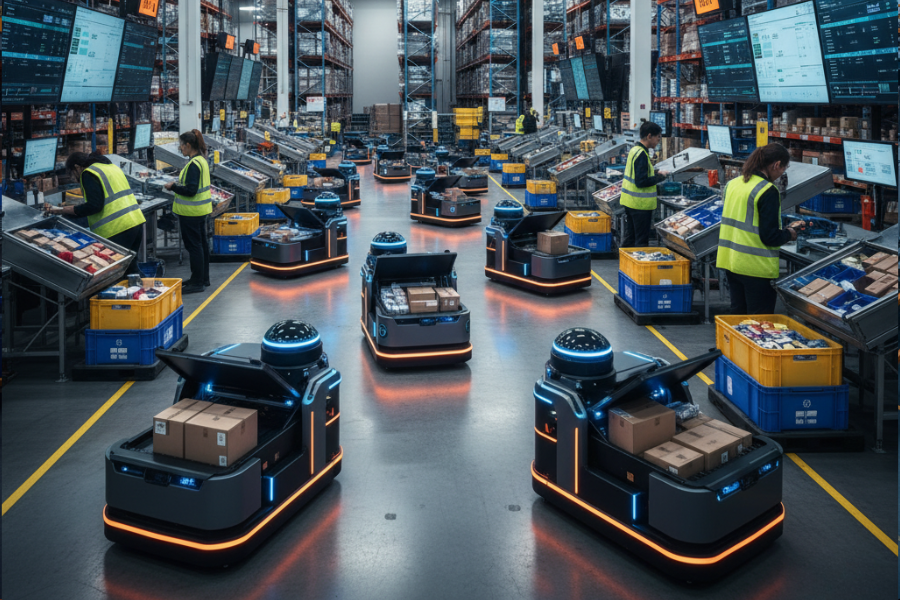
How AMRs Enable Both Picking and Sorting
AMRs bring mobility, intelligence, and flexibility to both processes without requiring fixed infrastructure.
AMR-Enabled Picking
- Robots carry totes/carts and follow or lead pickers (collaborative picking)
- Goods-to-person AMRs deliver shelves or totes directly to ergonomic stations
- Pick-assist AMRs with small robotic arms handle simple SKUs (emerging 2025–2026 trend)
- Reduces walking (50–70% of picker time) → pick rates rise from ~100–150 to 250–450+ UPH
AMR-Enabled Sorting
- Mobile sortation — AMRs with tilt-trays, cross-belt, or conveyor tops transport parcels and divert them to correct chutes/lanes
- Dynamic buffering & sequencing — Robots hold items temporarily and release in optimal order for packing or truck loading
- Carrier sortation — AMRs route parcels to carrier-specific zones (UPS, FedEx, DHL, local couriers) in real time
- Micro-fulfillment & urban dark stores — Compact AMRs sort small orders for same-hour delivery
Hybrid models are increasingly common: AMRs handle transport between picking zones and sortation areas, creating a continuous material flow with minimal human transfers.
Warehouse Sorting Robot Example
Vision and AI Technologies Powering Modern Systems
Advanced warehouse picking and sorting robots rely on a stack of perception and decision-making technologies:
- LiDAR + SLAM — 360° mapping and dynamic obstacle avoidance in shared human-robot spaces
- 3D Depth Cameras & RGB Vision — Object recognition, dimensioning, barcode/QR reading, damage detection
- AI / Machine Learning Models
- Item classification (clothing vs electronics vs fragile)
- Grasping pose estimation (for robotic picking arms)
- Anomaly detection (misplaced items, packaging defects)
- Predictive routing & traffic optimization
- OCR + Barcode/RFID Reading — High-speed label reading while robots are moving
- Edge AI Processing — On-robot inference for low-latency decisions (critical at sortation speeds of 1–2 m/s)
- Fleet Management AI — Task assignment, congestion prediction, energy optimization across dozens/hundreds of robots
These technologies allow AMRs to operate safely at higher speeds, handle greater SKU variability, and achieve error rates below 0.05–0.1% in mature deployments.
Throughput Improvement & Measurable Gains
Real-world AMR-based picking and sorting implementations deliver significant KPI lifts:
- Picking throughput
Manual → 80–150 UPH
AMR-assisted → 250–500+ UPH (2–4× improvement)
Goods-to-person + AMR sortation → up to 600–800 UPH in optimized zones - Sorting throughput
Manual sort walls → 500–1,200 parcels/hour per operator
AMR mobile sortation → 2,000–10,000+ parcels/hour per system (depending on fleet size and layout) - Other gains
Labor reduction: 40–70% fewer operators needed for same volume
Accuracy: 99.5–99.95% (vs 97–99% manual)
Space efficiency: narrower aisles, reduced staging areas
Peak handling: add robots temporarily instead of hiring surges
ROI: typically 12–36 months (faster in high-wage markets or 3PL operations)
Leading adopters (large e-commerce, parcel carriers, fashion & grocery retailers) report 30–60% overall process time reduction from pick-to-ship when combining AMR picking with AMR sorting.
Conclusion
Warehouse picking and sorting robots — especially those powered by Autonomous Mobile Robots (AMRs) — are closing the gap between high-volume demand and labor-constrained supply by delivering accurate, high-speed, flexible automation across both processes. Vision AI, dynamic routing, and intelligent fleet coordination enable these systems to handle diverse SKUs, tight SLAs, and seasonal peaks far more effectively than manual or fixed-automation alternatives.
As e-commerce parcel volumes continue to grow, AMR-based picking and sorting will become standard infrastructure for competitive fulfillment operations. Dive deeper into the full range of mobile robot solutions in our pillar guide: [Internal Link: Mobile Robots for Warehouse Management].
Ready to evaluate picking and sorting automation for your warehouse? Contact specialists for a throughput simulation and ROI projection tailored to your operation.
To understand how these systems work together, read our complete guide on mobile robots for warehouse management.