
Introduction to Order Picking Robots
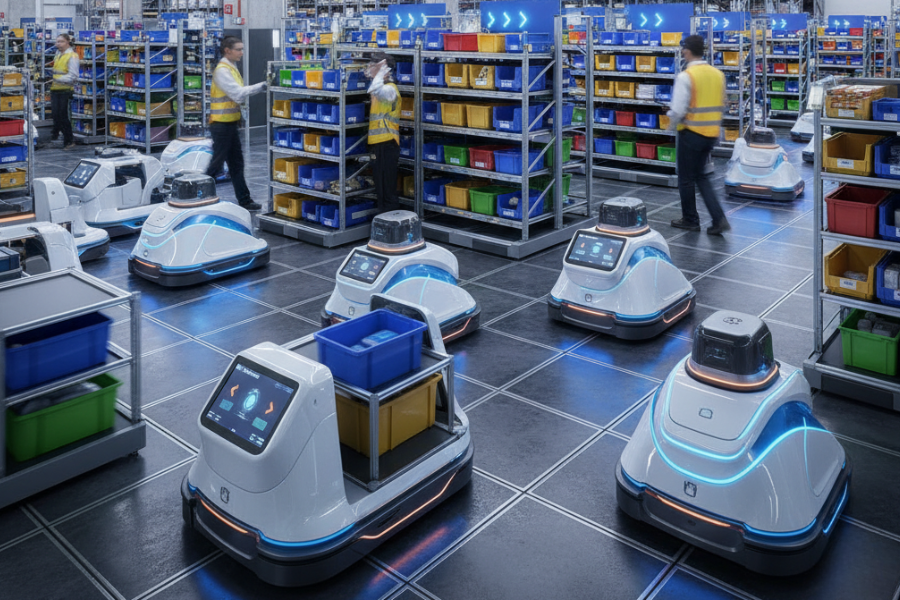
Order picking remains one of the most labor-intensive and costly activities in warehouse operations, often accounting for 50-70% of total fulfillment expenses. Order picking robots — particularly those powered by Autonomous Mobile Robots (AMRs) — are changing this dynamic by automating transport, guiding workers, or even performing picks themselves, while keeping humans in the loop for flexibility and complex decisions.
These systems range from simple follow-me AMRs that carry totes to advanced collaborative setups with robotic arms. By minimizing walking (the biggest time sink in traditional picking), order picking robots enable faster, more accurate fulfillment — critical in today’s e-commerce-driven environment with rising SKU variety and same-day delivery expectations.
This cluster article explores AMR-based order picking in detail. For the full spectrum of mobile robot applications in warehouses, refer to our pillar guide: [Internal Link: Mobile Robots for Warehouse Management].
Order Picking Challenges in Modern Warehouses
Traditional manual order picking faces several persistent hurdles:
- Excessive Walking Time — Pickers spend 50-70% of their shift traveling between locations, reducing actual picking time to just 15-20%.
- Labor Shortages & High Turnover — Physically demanding work, repetitive strain, and seasonal demand spikes make staffing difficult and expensive.
- Accuracy Pressure — Human error rates of 1-3% lead to costly returns, rework, and customer dissatisfaction.
- Scalability Limits — Adding throughput often requires proportional increases in headcount and space, which is unsustainable during peaks.
- Variable SKUs & Order Profiles — E-commerce brings high SKU counts, small orders, and frequent changes, complicating efficient batching or zoning.
These challenges drive warehouses toward automation that augments — rather than replaces — human workers.
AMR-Based Order Picking Workflow
Order picking robots using AMRs follow structured yet flexible workflows:
- Order Release & Assignment — Warehouse Management System (WMS) batches orders and assigns tasks to human-robot teams.
- Robot Retrieval — AMR navigates autonomously (via SLAM + LiDAR) to retrieve totes, shelves, or carts from storage zones.
- Guided or Assisted Picking —
- Directed Picking: Robot follows or leads the worker, displaying next pick via screen/voice; worker picks into robot-carried tote.
- Goods-to-Person Hybrid: Robot brings multiple totes to a station where worker picks from presented items.
- Pick Assist with Manipulation: Advanced AMRs with arms/grippers handle simple picks, escalating complex items to humans.
- Validation & Confirmation — Voice, scan, or vision confirms picks; robot updates WMS in real time.
- Transport to Packing/Shipping — AMR delivers completed orders to put walls, sorters, or outbound areas.
This workflow eliminates non-value-added travel, enabling pick rates of 200-400+ units per hour per operator in optimized setups.
Human-Robot Collaboration in Order Picking
The most successful deployments emphasize human-robot collaboration (cobotics) rather than full replacement:
- Benefits:
- Workers focus on dexterous, judgment-based picking while robots handle navigation and heavy transport.
- Reduced physical strain lowers fatigue, injuries, and turnover.
- Robots provide real-time guidance (voice, lights, AR), improving accuracy and training speed.
- Dynamic task allocation adapts to order surges or exceptions.
- Collaboration Models:
- Picker Leads Robot — Human directs; robot follows with tote (high flexibility).
- Robot Leads Picker — AMR guides worker along optimized path (max speed).
- Swarm / Zone-Based — Multiple AMRs serve pickers who switch between bots (high throughput).
Studies show collaborative setups reduce picking time by 20-40% vs manual, with workers reporting higher job satisfaction due to less walking and more meaningful tasks.
Productivity Improvements with Order Picking Robots
Real-world data highlights dramatic gains:
- Pick rates often increase 2-4× (from 80-150 picks/hour manual → 200-400+ with AMRs).
- Labor requirements drop 30-60% for the same volume.
- Order fulfillment speed improves, enabling same-day shipping.
- Accuracy reaches 99.9%+ with guided validation.
- Throughput scales easily by adding robots during peaks.
Case examples include e-commerce and 3PL operations reporting doubled productivity, 40-70% labor cost reductions, and ROI within 12-24 months.
Comparison: Order Picking Robots vs Manual Picking
| Aspect | Manual Picking | AMR-Based Order Picking Robots |
|---|---|---|
| Walking/Travel Time | 50-70% of shift | Reduced by 70-90% |
| Pick Rate (UPH) | 80-150 | 200-400+ (2-4× improvement) |
| Accuracy | 97-99% | 99.5-99.9%+ |
| Labor Cost per Order | High (proportional to volume) | 30-60% lower |
| Scalability | Limited by headcount & fatigue | Highly scalable via fleet addition |
| Worker Fatigue/Injury | High | Significantly reduced |
| Initial Investment | Low | Moderate (fast ROI) |
AMR systems excel in high-volume, variable environments; manual remains viable for very low-volume or specialized tasks.
Conclusion
Order picking robots powered by Autonomous Mobile Robots (AMRs) directly tackle the core inefficiencies of traditional warehouse picking — excessive travel, labor dependency, and error rates — while preserving human flexibility through smart collaboration. The result is 2-4× higher productivity, safer workplaces, and scalable operations ready for e-commerce growth.
As labor costs rise and delivery expectations tighten, these systems are becoming essential infrastructure. Explore how order picking robots fit your facility — start with our comprehensive pillar guide: [Internal Link: Mobile Robots for Warehouse Management].
Ready to boost your picking performance? Contact AMR specialists for a workflow assessment and see the difference collaborative robotics can make.
To understand how these systems work together, read our complete guide on mobile robots for warehouse management.