
IoT Cost Estimation is often the difference between a successful product launch and a failed prototype. Many engineers build functional demos but fail when scaling to thousands of units because they overlooked the Bill of Materials (BOM).
Introducing IoT Cost Challenges
Unlike software, IoT products have physical costs. Every sensor, screw, and certification adds expense. The biggest challenge? Hidden costs like assembly, logistics, and compliance often double the initial budget.
Why BOM Planning is Critical
Without a detailed BOM, you cannot predict profit margins. Startups frequently burn capital on overpriced components or face production halts due to obsolete parts. Proper BOM planning ensures your IoT product costing aligns with market reality.
Brief Intro to RobologicsLab.com
At RobologicsLab.com, we focus on IoT, embedded systems, and practical engineering education. Our platform helps engineers and startups build scalable IoT solutions by bridging the gap between prototype and production. This guide is part of our commitment to demystifying hardware development.
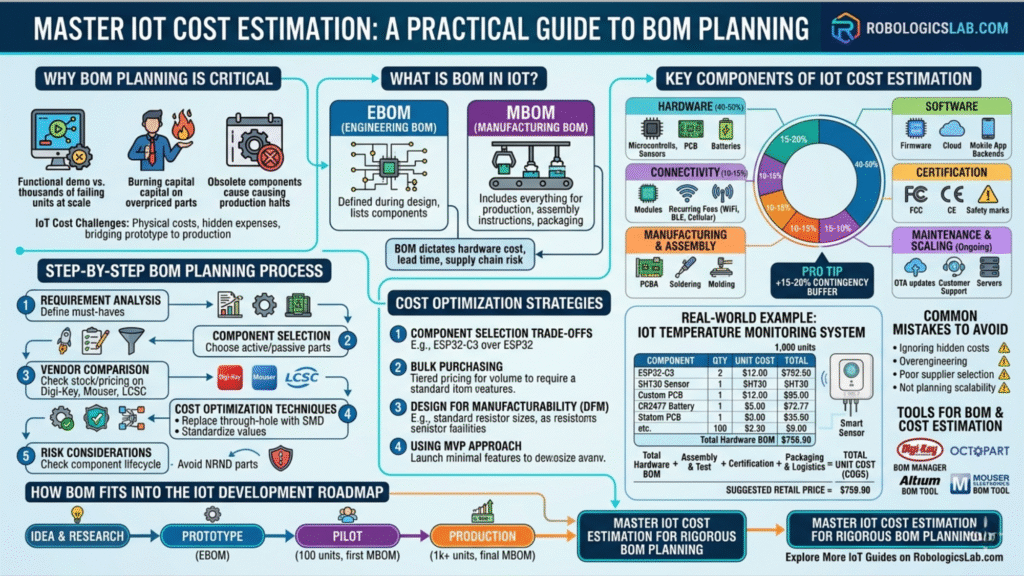
What is BOM in IoT?
A Bill of Materials (BOM) is the complete list of raw materials, components, sub-assemblies, and instructions required to manufacture your IoT device.
Types of BOMs
- Engineering BOM (EBOM): Defined during design. Lists components as they appear on the schematic (e.g., a specific temperature sensor).
- Manufacturing BOM (MBOM): Includes everything needed for assembly line production, including screws, packaging, and soldering paste.
Importance in IoT Product Development:
For IoT, the BOM dictates hardware cost, lead time, and supply chain risk. A missing Wi-Fi module on your BOM means a missing feature in your final product.
Key Components of IoT Cost Estimation
To master IoT Cost Estimation, break your budget into six distinct layers.
- Hardware (40-50% of BOM): Sensors (humidity, motion), microcontrollers (ESP32, nRF52), PCB (boards, connectors), power supply (batteries, regulators).
- Software (15-20%): Firmware development, cloud infrastructure (AWS IoT, Azure), mobile/web app backends.
- Connectivity (10-15%): Module costs + recurring fees. Options include WiFi, Bluetooth, Cellular (GSM/4G), or LoRaWAN.
- Manufacturing & Assembly (10-15%): PCB assembly (PCBA), soldering, testing, and enclosure molding.
- Certification (5-10%): CE (Europe), FCC (USA), RoHS, and industry-specific safety marks.
- Maintenance & Scaling (Ongoing): Over-the-air (OTA) updates, customer support, and server costs.
💡 Pro Tip: Always add a 15-20% contingency buffer for supply chain volatility, especially for semiconductors.
Step-by-Step BOM Planning Process
Follow these steps to build a production-ready BOM.
- Requirement Analysis: Define absolute must-haves (e.g., battery life > 2 years) vs. nice-to-haves.
- Component Selection: Choose active components (MCU, sensors) and passives (resistors, capacitors).
- Vendor Comparison: Check stock and pricing on Digi-Key, Mouser, and LCSC.
- Cost Optimization Techniques: Replace through-hole parts with SMD; use standard resistor values.
- Risk Considerations: Avoid “NRND” (Not Recommended for New Designs) parts. Check component lifecycle (5+ years).
Cost Optimization Strategies
Reducing IoT Hardware Cost Breakdown doesn’t mean using cheap parts. It means smart engineering.
- Component Selection Trade-offs: An ESP32-C3 ($2.50) might replace an ESP32 ($4.00) if Bluetooth 5 is enough.
- Bulk Purchasing: 100 units cost 10x more per component than 10,000 units. Plan tiered pricing.
- Designing for Manufacturability (DFM): Use 0603 or 0805 resistors (easier to place) instead of 0201 (requires expensive pick-and-place machines).
- Using MVP Approach: Launch with a minimal feature set. Remove unproven sensors. (Related: See our pillar article on MVP development for hardware).
Real-World Example: IoT Temperature Monitoring System
Let’s estimate a simple Smart Home Temperature & Humidity sensor (Battery powered, reports every 15 mins via BLE/WiFi).
Sample BOM Table (for 1,000 units)
| Component | Part Number Example | Qty | Unit Cost (1k) | Total Cost |
|---|---|---|---|---|
| Microcontroller | ESP32-C3 Mini | 1 | $2.20 | $2.20 |
| Temp/Humidity Sensor | SHT30 | 1 | $1.80 | $1.80 |
| PCB (2-layer, FR4) | Custom | 1 | $0.45 | $0.45 |
| Battery (CR2477) | Renata | 1 | $1.20 | $1.20 |
| Voltage Regulator | AP2112K-3.3 | 1 | $0.18 | $0.18 |
| Passives (R,C,LED) | Assorted 0805 | 15 | $0.01 | $0.15 |
| Enclosure (ABS) | Custom mold | 1 | $0.90 | $0.90 |
| Total Hardware BOM | $6.88 |
Estimated Cost Breakdown (Final Product)
- BOM Hardware: $6.88
- Assembly & Test: $1.50
- Certification (FCC/CE amortized): $0.80
- Packaging & Logistics: $0.50
- Total Unit Cost (COGS): $9.68
- Suggested Retail Price: $29.99 (Gross margin ~67%)
Common Mistakes to Avoid
- Ignoring hidden costs: Forgetting the programming header, test points, or ESD protection diodes.
- Overengineering: Using a 32-bit MCU with 1MB flash to blink an LED.
- Poor supplier selection: Relying on a single Chinese vendor without a backup (e.g., JLCPCB + Seeed Studio).
- Not planning for scalability: Designing a board that requires manual soldering of a QFN package.
Tools for BOM & Cost Estimation
Leverage these high-authority tools to automate your IoT BOM Planning.
- Digi-Key BOM Manager – Upload a CSV, get live pricing and stock levels.
- Octopart – Compare prices across Mouser, Arrow, and Newark simultaneously.
- Altium BOM Tool – Integrates with PCB design for real-time cost tracking.
- Mouser Electronics BOM Tool – Instant quoting and part validation.
How BOM Fits into the IoT Development Roadmap
Your BOM is not a one-time document; it evolves.
- Idea & Research: High-level cost blocking (e.g., “Under $15 BOM”).
- Prototype: Engineering BOM (EBOM) – expensive dev boards allowed.
- Pilot (100 units): First Manufacturing BOM (MBOM) – cost optimization begins.
- Production (1k+ units): Final MBOM with contract manufacturer (CM).
Strongly connect to the pillar article: For the full lifecycle, read our guide on the IoT Development Roadmap where cost planning sits at every gate review between phases.
Conclusion
Mastering IoT Cost Estimation requires rigorous BOM Planning. Remember that the cheapest component on paper often becomes the most expensive after assembly, logistics, and rework.
Start by building a simple BOM in Excel, verify prices on Octopart, and always design for manufacturability. For deeper dives into embedded systems and hardware engineering, explore more guides on RobologicsLab.
Ready to build? Explore more IoT guides on RobologicsLab or Start building your IoT product today with our prototyping checklists.
Frequently Asked Questions (FAQs)
What is BOM in IoT?
A Bill of Materials (BOM) in IoT is a comprehensive list of all components—from microcontrollers to screws—required to build a physical connected device. It includes part numbers, quantities, and sourcing details essential for manufacturing.
How do you estimate the cost of an IoT product?
To estimate IoT product costing, sum the Hardware BOM, PCB Assembly (PCBA), enclosure tooling, certification fees (FCC/CE), and cloud connectivity costs over 3 years. Use tools like Digi-Key’s BOM Manager for accurate component pricing.
What are the major cost drivers in IoT development?
The top three cost drivers are semiconductors (MCU, radios), certification (wireless testing is expensive), and non-recurring engineering (NRE) like mold tooling and firmware development.
How can startups reduce IoT product costs?
Startups can reduce costs by using module-over-SoC initially (e.g., ESP32 module), designing for a single PCB, avoiding custom enclosures for MVP, and choosing components with wide supply chain availability.
What tools are used for BOM planning?
Leading tools include Octopart for price comparison, Altium for design-integrated BOMs, and Mouser/Digi-Key’s free BOM managers for rapid quoting. For collaboration, PartsBox is popular among small hardware teams.